

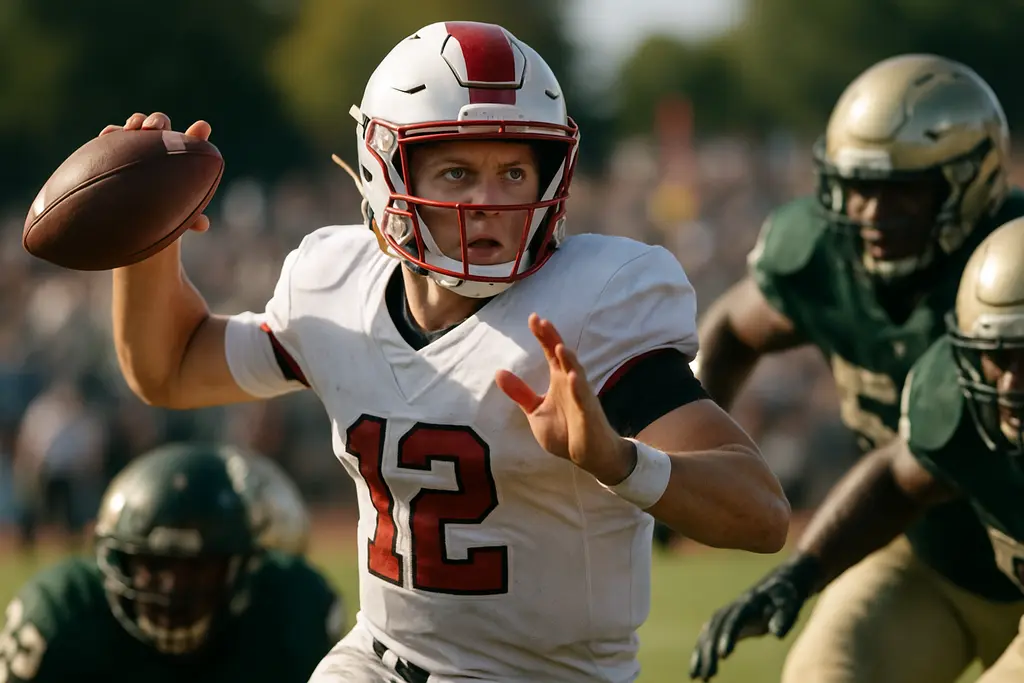
By October 10, 2026, the September slate that once sat on calendars as a group of upcoming showcases had become part of the scouting record for high school recruits across the South and Midwest. For readers in Alabama, that matters because the best local football conversations rarely stop at the state line. Georgia, Louisiana and Illinois matchups help shape how regional talent is discussed, how families track development, and how coaches compare prospects who play under real Friday-night pressure.
That is especially true for Buford and Grayson, two Georgia programs with the kind of roster depth that draws attention well beyond metro Atlanta. Their September 18, 2026 meeting in Loganville was not just a neighborhood result. It was a measuring stick for players already carrying offers, commitments and reputations into the heart of the fall schedule.
Why High School Recruits Stood Out In September
High School Recruits In The Buford-Grayson Spotlight
Buford entered its September 18 game against Grayson at 3-0 with an 18-game winning streak and had outscored opponents 98-33 before kickoff, according to Georgia Public Broadcasting. That kind of start gave the night a clear competitive edge before the first snap. Grayson brought its own weight into the matchup, with 45 players holding college offers, while Buford had 27. GPB also reported that Buford senior Jameer Cantrell was a 3-star safety committed to Arkansas and that junior AJ Granville was a 4-star prospect with offers that included South Carolina.
The final score added another layer to the evaluation. Buford defeated Grayson 23-13 on September 18, 2026, and the posted scoring breakdown showed Grayson was held scoreless in the third and fourth quarters, per MaxPreps. For scouts and local observers, that second-half shutout mattered. It suggested that Buford adjusted after trouble and finished with control, the sort of detail that can speak as loudly as a prospect list.
The research notes for that game also identified Jalen Brewster, a senior defensive lineman listed at 6-foot-3 and 300 pounds, as a consensus 5-star prospect committed to Texas Tech. Grayson’s offensive line was noted for college-level interest as well, including Jordan Agbanoma, who was committed to Nebraska. Put together, the game carried the look of a regional evaluation stop, not because of any single name, but because so many players were being judged against strong competition in one setting.
How A Result Changes The Recruiting Conversation
For high school recruits, a game like Buford-Grayson can sharpen the record. A player’s star rating or offer sheet tells part of the story. A game against another loaded roster shows something different: how a safety fits run support, how a lineman handles fatigue, how a quarterback responds when the game slows down late, and how a defense communicates after halftime.
That second-half piece was the cleanest takeaway from Buford’s 23-13 win. The Wolves were behind on the scoreboard early, then finished with the stronger close. Even without adding unsupported claims about individual grades, it is fair to say the team result gave Buford’s prospects a stronger performance context after September 18. Grayson still remained a program with major talent in the research, but the night itself belonged to Buford’s response.
Regional Matchups With Recruiting Weight
Edna Karr And Ruston Added A Louisiana Test
Another September result in the research came from Louisiana, where Edna Karr and Ruston met on September 19, 2026 at Caesars Superdome. The supplied notes described Edna Karr as 3-0 entering the contest and Ruston as 2-1, with Edna Karr holding on in a one-score game. The report also identified several key performers: Edna Karr senior running back Jermond Macklin rushed 14 times for 78 yards and scored all three of his team’s touchdowns, while Ruston junior running back Dalen Powell rushed for 124 yards on 17 carries, including a 71-yard touchdown.
That kind of back-and-forth carries value in recruiting discussion because it gives evaluators a compact sample of production under pressure. Macklin’s workload pointed to trust in short-yardage and scoring situations. Powell’s yardage, including the long touchdown, showed the explosive element that can change a game quickly. Ruston pass catchers Josiah Morgan and Ahmad Hudson were also noted in the research, with Morgan catching four passes for 33 yards and Hudson catching four for 29.
For Alabama readers, Louisiana football has always been worth watching with respect. The states share a Gulf South football identity built on tough line play, fast defensive backs and running backs who often carry heavy Friday-night workloads. The Edna Karr-Ruston result fit that model: a close game, a neutral-site stage, and players earning notice through production rather than noise.
Illinois Quarterbacks Brought Early-Season Context
The Illinois games listed in the research had already passed by October 10, 2026, but they were included as early-season matchups with clear quarterback interest. Maine South at Batavia featured senior quarterback Jameson Purcell, an Indiana commit who had thrown for 2,572 yards, 30 touchdowns and seven interceptions the prior season while completing about 70 percent of his passes. Opposing quarterback Michael Vander Luitgaren, identified as a Wyoming recruit, had thrown for 2,708 yards, 31 touchdowns and four interceptions with about a 65 percent completion rate.
Carmel at Hersey also carried a quarterback-centered recruiting angle in the research. Jake Nawrot, a senior quarterback committed to Kentucky, was listed as having thrown for 3,078 yards, 41 touchdowns and two interceptions the previous season. His top target, junior receiver Josh Riggs, was credited with catching 11 of those touchdown passes. Those numbers belonged to the prior season, not the final result of the 2026 matchup, so they should be read as context for why that August game drew attention.
Those Midwest examples may sit outside Alabama’s usual Friday travel map, but they still offer a useful comparison point. Quarterback evaluation often travels well across state lines because decision-making, accuracy and turnover control can be compared from one program to another. The details in the research gave those games a clear reason to be part of the same conversation as the Southern matchups.
What Alabama Fans Can Take From These Games
Alabama high school football followers are used to seeing college-level players before national audiences catch up. That is why regional games like Buford-Grayson and Edna Karr-Ruston feel familiar. The setting may be across the border, but the rhythm is recognizable: packed sidelines, families following offer lists, coaches trying to balance team goals with outside attention, and players asked to keep performing with college labels attached to their names.
There is also a historical thread here. Recruiting has long moved along familiar roads from small towns and suburban programs to college campuses across the SEC footprint. Not every prospect in these matchups was tied to an Alabama school, and the research does not support saying otherwise. Still, games loaded with high school recruits can influence how regional programs are compared by fans, media and coaches during the fall.
For a closer Alabama frame on how early games shaped scouting talk, our earlier look at high school matchups put Alabama talent first connects the same idea to in-state programs and local player development. The common thread is not hype. It is the value of seeing prospects in real game conditions, against opponents talented enough to expose weak habits and reward preparation.
- Buford-Grayson showed how a deep roster responds after early pressure.
- Edna Karr-Ruston gave running backs and receivers a close-game stage.
- The Illinois matchups offered quarterback production as the main evaluation frame.
What The Fall Matchups Say About High School Recruits
The strongest lesson from these games is that high school recruits are best judged through context. A commitment matters. A star rating matters. So does the opponent, the quarter, the score, the game site and the way a player performs after halftime. Buford’s 23-13 win over Grayson on September 18, 2026 is the clearest supported example in the research because the final score and scoring pattern are available from a high-authority results source.
As the 2026 fall calendar moves past these September games, the record now gives coaches, families and local fans something firmer to discuss. The names remain important, but the games gave those names shape. That is how Friday nights have always worked in this part of the country: reputations begin on paper, then they are tested under lights, in front of communities that remember how the game was won.