


Jordan Faison Football is a story rooted in South Florida range, Notre Dame patience, and the hard choice to narrow a wide athletic identity. Born on April 7, 2004, and raised in Weston, Florida, Faison grew through Pine Crest as a three-sport athlete in football, lacrosse, and basketball. That background matters because his rise has not followed the straight path often associated with major college football. It has moved through cross-training, role changes, physical strain, and a January 2026 decision to step away from lacrosse so he could commit his preparation to one sport.
Jordan Faison Football And The South Florida Base
Jordan Faison Football Roots In Weston
For South Florida readers, the local starting point is more than a line in a player bio. Weston and Pine Crest sit inside a region where speed, multi-sport schedules, private-school competition, and year-round training often shape young athletes before college coaches ever make a call. Faison’s high school profile reflected that setting. In his final high school football season during the 2022-2023 school year, he rushed for 1,661 yards, scored 23 rushing touchdowns, threw six more touchdown passes, and also played on defense.
That production came in a Wing-T offense, which makes his later development as a Notre Dame receiver more interesting. He was not simply running a modern passing tree every Friday night. He was carrying the ball, reading contact, helping on defense, and using the kind of open-field instincts that can come from playing several sports. The point is not that every athlete should copy his path. The point is that his range gave Notre Dame an athlete who still had room to be shaped once football became the main assignment.
A Three-Sport Skill Set
Faison’s lacrosse résumé was strong enough to bring him to Notre Dame first. He was ranked inside the national Top 50 as a lacrosse recruit, committed to Notre Dame for lacrosse in fall 2021, and arrived as a partial-scholarship lacrosse player before walking onto the football team, as detailed by ESPN’s Faison profile. That piece of the story gives his football rise a local-development feel: he was not handed a standard Power Four receiver track from the start.
Basketball, lacrosse, and football ask different things from the body and mind. Basketball adds spatial awareness in traffic. Lacrosse sharpens change of direction, stick-side deception, and quick burst. Football demands repeated contact, route detail, and timing with a quarterback. Faison’s early years mixed all of that together. At Notre Dame, the challenge became deciding which parts of that background could help him most, and which schedule demands were starting to take too much from recovery.
From Lacrosse Recruit To Notre Dame Receiver
Walking On While Carrying Two Seasons
Faison played both sports through his freshman and sophomore years at Notre Dame, with football in the fall and lacrosse in the spring. That workload speaks to more than talent. It asks for class discipline, treatment-room time, quick resets, and a willingness to change teams without losing edge. For a young athlete from South Florida, it also meant adapting to a campus and competitive environment far from the rhythms of home.
His football production through three seasons from 2023-2025 showed steady value: 98 receptions, 1,318 receiving yards, and nine receiving touchdowns. In lacrosse across the spring 2024 and spring 2025 seasons, he played 29 games with 31 goals and 13 assists. Those numbers show why the decision to leave lacrosse was not a small move. He was not stepping away from a side hobby. He was stepping away from a sport where he had already contributed at a major program.
Growth Beyond The Box Score
The key lesson in Jordan Faison Football is that personal growth sometimes looks like subtraction. Young athletes are often praised for doing everything, and Faison had earned that kind of praise. Yet the college calendar can turn versatility into pressure. Two sports can sharpen a player, but they can also cut into rest, technical sessions, strength gains, and the mental reset needed between seasons.
By January 2026, Faison had stopped playing lacrosse so he could prepare for his senior football season. The timing placed spring and fall 2026 training in a different frame. Instead of recovering from lacrosse and then shifting back to football, he could spend those windows on receiver-specific work, body recovery, and leadership inside the football building. The human part of that decision should not get lost. Leaving a sport that helped define his college entrance required humility and clarity.
What Changed After Leaving Lacrosse
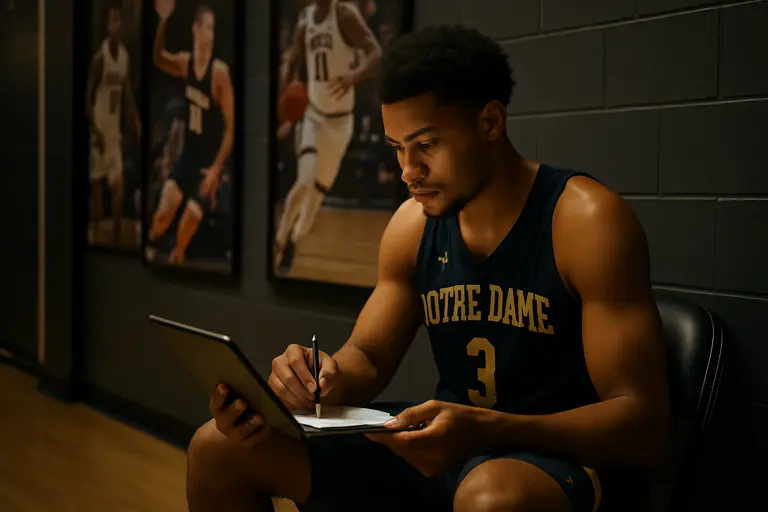
Recovery Became Part Of Development
Faison’s improved football preparation after leaving lacrosse was tied to the kind of body recovery that can be hard to notice from the stands. Football fans often see the catch, the release at the line, or the touchdown. They may not see the accumulated cost of spring practices, travel, contact, conditioning, and the lack of a true reset. In 2026, Faison had the benefit of a more focused offseason. That gave his football training more continuity and gave his body a better chance to absorb the work.
The results through early October 2026 supported that shift. As of October 7, 2026, after Notre Dame’s first five games, Faison led the Irish with 25 catches, 371 receiving yards, and four touchdowns. Notre Dame was 5-0 and averaging 41.2 points per game, according to a FOX Sports report. Those figures do not prove that one choice caused every gain, but they do show that his narrowed focus fit a productive start.
Captaincy And Responsibility
Another marker came through leadership. In early September 2026, Faison was reported as one of Notre Dame’s four captains, his first such honor since arriving in South Bend. That matters because captaincy is rarely about catches alone. It reflects trust, daily conduct, and the ability to carry responsibility in front of teammates. For a former walk-on football player who came to campus on a lacrosse path, that role says as much about maturity as it does about talent.
Jordan Faison Football now reads like a study in identity change. He did not reject his past as a lacrosse player. He used it, then made a choice when the next stage required a different commitment. That is a useful message for local athletes in South Florida and Indiana alike. Development is not always about adding one more camp, one more sport, or one more obligation. Sometimes it is about recognizing the moment when focus creates a better version of the athlete already there.
Why Jordan Faison Football Resonates In Notre Dame Culture
A Local Story With A National Program
Notre Dame’s football culture has long drawn players from across the country, but each athlete still brings a hometown imprint. Faison’s South Florida roots show up in the speed and comfort in space that helped him cross from lacrosse recruit to football captain. South Bend gave that athletic base a different test: colder weather, national attention, and a football program where every role is measured closely. The blend of Weston training habits and Notre Dame expectations is what makes his story fit the Beyond the Game lens.
For families following player development, the best takeaway is not that every dual-sport athlete should specialize early or late. Faison’s path shows the value of honest timing. His high school years rewarded range. His first college years proved he could compete across two sports. His 2026 choice showed he was willing to adjust when football demanded more specific preparation. Jordan Faison Football stands as a respectful reminder that growth in sports is often personal before it becomes public.