

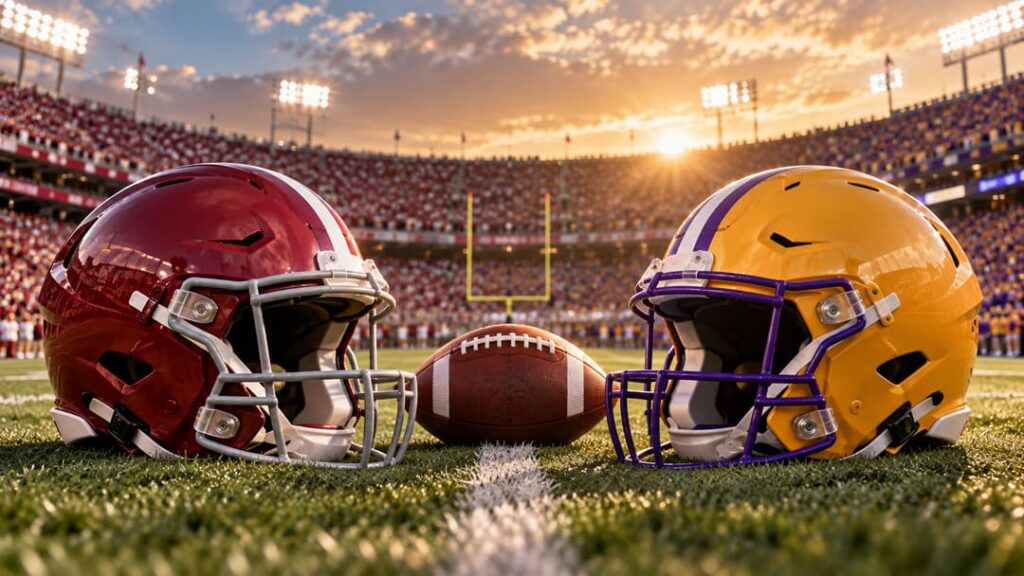
Alabama ended its two-game losing streak with a 31–20 victory over Texas A&M on October 24, but the result left an important question unanswered: Has the Crimson Tide actually solved its offensive problems? With LSU waiting on November 7, Alabama football odds and the team’s recent performances tell different parts of the story.
The win moved Kalen DeBoer’s team to 6–2 overall and 4–2 in SEC play. It followed consecutive losses to Georgia and Tennessee, including a particularly troubling afternoon in Knoxville. Crimson Traditions previously examined Alabama’s offensive struggles against Tennessee, when the Tide produced only 201 total yards and committed four turnovers. The Texas A&M performance showed measurable improvement, although several weaknesses remained.
For supporters following betting markets, there is another distinction worth making: a point spread evaluates a matchup, while a sportsbook review evaluates the platform offering it. Readers asking Is BetAnything safe? can examine TheRX’s discussion of the operator’s offshore status, withdrawal conditions and licensing transparency. Such reviews do not establish that a sportsbook is legally authorized or risk-free. Alabama still has no state-regulated sports betting market, so football odds should not be confused with permission to wager locally.
Why Alabama Football Odds Tell a Different Story From the Final Score
Winning a football game and exceeding betting-market expectations are two separate accomplishments.
Alabama entered the Texas A&M contest as a substantial favorite. CBS Sports recorded a closing point spread of Alabama -13.5, meaning the Crimson Tide needed to win by at least 14 points to cover that particular line.
The final margin was 11 points.
Although Alabama secured an important victory, it finished 2.5 points short of covering that spread. The result illustrates why a straight-up record cannot independently establish whether a team’s performances have consistently exceeded market expectations.
There is another important detail behind the scoreboard.
Alabama scored 31 points, but seven came from Dijon Lee Jr.’s 39-yard interception return for a touchdown in the first quarter. The offense itself contributed 24 points through three touchdown passes and a field goal.
That distinction matters when assessing offensive improvement. A defensive touchdown is valuable, but it should not be counted as evidence that the offense suddenly became more productive.
The numbers must be separated before Alabama’s progress can be evaluated fairly.
What Actually Improved Between Tennessee and Texas A&M?
The strongest argument for Alabama’s progress comes from comparing its last two games.
The official Alabama game statistics show that the Crimson Tide generated 379 total offensive yards against Texas A&M, a substantial increase from its performance at Tennessee.
| Performance Metric | At Tennessee, Oct. 17 | Vs. Texas A&M, Oct. 24 |
|---|---|---|
| Final score | Lost 26–10 | Won 31–20 |
| Total offensive yards | 201 | 379 |
| Passing yards | 147 | 311 |
| Net rushing yards | 54 | 68 |
| Third-down conversions | 2 of 13 | 5 of 12 |
| Turnovers committed | 4 | 1 |
The improvement in passing production was unmistakable. Alabama generated 164 more passing yards than it did against Tennessee while reducing its turnovers from four to one.
Third-down performance also improved, rising from approximately 15.4% against the Volunteers to 41.7% against the Aggies.
However, the rushing numbers remained concerning.
Alabama gained only 14 additional net rushing yards compared with the Tennessee game, despite recording two more rushing attempts.
This creates a mixed assessment: the passing game recovered, ball security improved and the offense sustained more drives, but Alabama still struggled to establish a dependable ground attack.
For supporters assessing the team’s future performances, that distinction is more valuable than treating the final score as a complete measure of progress.
Keelon Russell and Rico Scott Provided the Offensive Breakthrough
Quarterback Keelon Russell delivered one of his more productive passing performances of the season against Texas A&M.
The sophomore completed 19 of 30 attempts for 311 yards, three touchdowns and one interception. His two fourth-quarter touchdown passes helped Alabama turn a 20–17 deficit into a comfortable advantage.
Wide receiver Rico Scott played a major role in that recovery.
Scott caught six passes for 156 yards, accounting for approximately half of Alabama’s total passing yardage. His ability to create explosive gains helped compensate for the team’s limited rushing production.
Lotzeir Brooks also contributed three receptions for 73 yards, giving Russell another productive option.
Together, those performances demonstrated that Alabama’s passing offense still has explosive potential, even after its difficulties against Georgia and Tennessee.
Yet the concentration of passing production raises another question.
If opponents devote additional coverage attention to Scott, can Alabama consistently generate productive possessions through its other receivers, tight ends and running backs?
The Texas A&M game provided encouraging evidence about Russell’s ability to respond under pressure. It did not establish that the offense can consistently operate without a balanced rushing attack.
That remains one of the central challenges facing DeBoer’s coaching staff.
Alabama’s Running Game Still Needs a Reliable Identity
Alabama finished the Texas A&M game with 68 net rushing yards on 28 attempts, averaging only 2.4 yards per carry.
Daniel Hill led the team with 36 yards on nine carries, while Russell contributed 20 net rushing yards.
Those figures are difficult to ignore for a program preparing to face another SEC opponent away from home.
An ineffective rushing game creates problems that extend beyond the total yardage.
When defenses can limit early-down rushing plays, quarterbacks face longer third-down distances. Pass protection becomes more demanding, and opposing coordinators can devote additional resources to disrupting passing routes.
Against Tennessee, Alabama’s inability to sustain drives contributed to its offensive struggles. Against Texas A&M, Russell’s passing production helped overcome some of those limitations.
But relying on exceptional passing execution is not the same as solving the underlying problem.
DeBoer’s staff must examine whether the rushing struggles stem primarily from blocking assignments, personnel availability, play design or inconsistent execution.
The bye week offers an opportunity to evaluate those issues before LSU.
Improving rushing efficiency does not necessarily require a dramatic philosophical change. Alabama needs more productive early-down plays and enough balance to keep opposing defenses from anticipating its next move.
Defensive Takeaways Made the Difference, but They Cannot Be Assumed
Alabama’s defense deserves considerable credit for how it responded against Texas A&M.
The Crimson Tide forced three turnovers, including Lee’s interception return. The defense also restricted the Aggies to just 15 yards in the fourth quarter.
That closing performance was particularly important because Alabama had entered the final period trailing by three points.
The Tide outscored Texas A&M 14–0 over the final 15 minutes, combining offensive execution with defensive resistance.
Still, there is a difference between creating turnovers and depending on them.
Alabama finished with a plus-two turnover margin, giving its offense and defense advantages that will not necessarily appear in every future matchup.
If LSU protects the football more effectively, Alabama could face longer possessions and fewer opportunities to capitalize on short fields or defensive scores.
The more transferable defensive indicators involve pressure, tackling, third-down efficiency and the ability to stop sustained drives without requiring an interception or fumble.
The Aggies converted only four of their 11 third-down opportunities. That is encouraging, but Alabama must demonstrate similar consistency against stronger offensive competition.
Defensive takeaways can change games. Consistent execution is what allows a team to remain competitive when those takeaways do not materialize.
What Alabama Must Establish Before the November 7 LSU Matchup
Alabama and LSU both enter their scheduled October 31 open dates with 6–2 records.
The Tigers improved to 6–2 overall and 3–2 in SEC play following their 38–17 victory over Auburn on October 24. The teams will meet at Tiger Stadium in Baton Rouge on November 7, with kickoff scheduled for 2:30 p.m. CT on ABC.
For Alabama, the upcoming matchup represents an opportunity to demonstrate that its improvements against Texas A&M can carry into another demanding conference environment.
Three areas deserve particular attention.
First, the Crimson Tide must establish more dependable rushing production. The offense cannot assume that Russell will consistently overcome poor early-down results through explosive passing plays.
Second, Alabama needs continued contributions from multiple receiving targets. Scott’s performance against Texas A&M was important, but a more diversified passing attack would make the offense harder to defend.
Third, the defense must maintain its fourth-quarter effectiveness without depending on opponents to surrender possession through turnovers.
Personnel availability also matters. Alabama entered the Texas A&M matchup with injuries affecting multiple position groups, and the coaching staff will need to evaluate its options as LSU week approaches.
None of these factors guarantees a particular outcome. They provide a more useful framework for evaluating Alabama than changing rankings or isolated betting lines.
The Texas A&M victory accomplished something important: it prevented a third consecutive defeat and restored confidence after a difficult two-week stretch.
But Alabama’s larger challenge remains unchanged.
The Crimson Tide must demonstrate that it can produce balanced offense, protect the football and sustain defensive performance against quality SEC opponents.
That is the standard by which the Texas A&M recovery should ultimately be judged, regardless of how Alabama football odds move before the LSU game.