

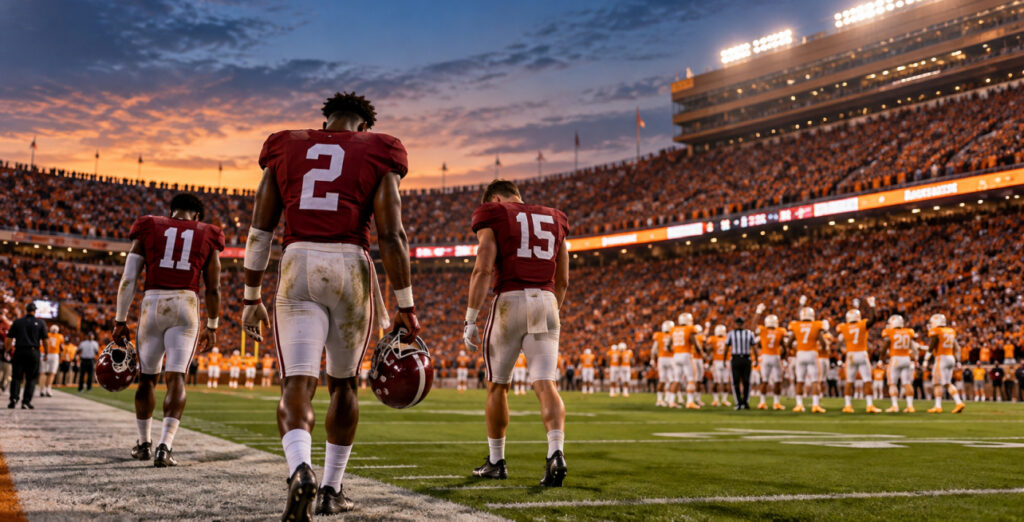
Alabama football entered the Third Saturday in October expecting another defining SEC rivalry battle. Instead, the Crimson Tide left Neyland Stadium with a 26–10 defeat against Tennessee on October 17, 2026, raising difficult questions about offensive execution, quarterback development and the direction of Kalen DeBoer’s program.
Alabama’s 26–10 defeat against Tennessee also highlights how college football influences conversations beyond the field, from conference championship expectations to the evolving legal framework surrounding sports wagering. While Crimson Tide supporters analyze Kalen DeBoer’s offensive adjustments and the team’s remaining SEC schedule, discussions about Alabama sports betting legislation provide a separate perspective on how state lawmakers approach the regulation of sports-related commercial activity. Alabama has not legalized sports betting, making it important to distinguish the state’s legislative debates from the competitive analysis, historical rivalries, and on-field performances that define Crimson Tide football.
The loss dropped Alabama to 5–2 overall and 3–2 in Southeastern Conference play. Tennessee improved to 6–1 overall and 3–1 in the SEC, strengthening its position in a competitive conference race.
For Alabama, the most troubling development was not simply the 16-point margin. It was how thoroughly Tennessee controlled the game.
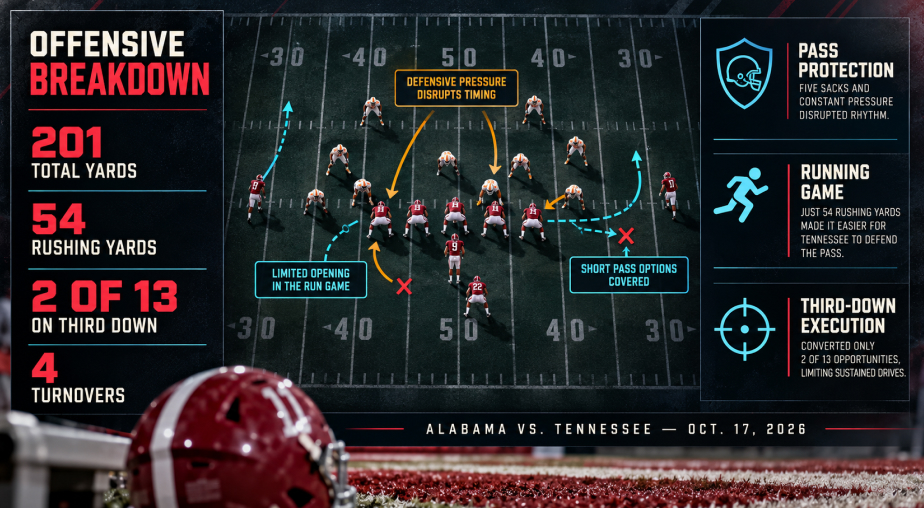
The Volunteers outgained Alabama 347–201, forced four turnovers and held the Crimson Tide scoreless throughout the second half. Alabama managed just 54 rushing yards, converted only two of 13 third-down opportunities and failed to produce a passing touchdown.
Quarterback Keelon Russell completed 19 of 29 passes for 147 yards with two interceptions. His 19-yard touchdown scramble in the second quarter provided Alabama’s only trip to the end zone.
According to the official Alabama–Tennessee game recap, the Volunteers led throughout the contest and used two second-half rushing touchdowns to turn a narrow halftime advantage into a decisive victory.
The performance followed Alabama’s 20–17 defeat against Georgia on October 10, creating consecutive losses for a team that opened the season with five victories.
That sequence has shifted the conversation surrounding DeBoer.
Alabama’s defense produced moments of resistance against Tennessee, but its offense struggled to sustain drives, establish a dependable running game or protect possession.
For a program built around championship expectations and offensive innovation, those shortcomings deserve closer examination.
Alabama Vs. Tennessee 2026: The Numbers Behind The 26–10 Defeat
The final score tells only part of the story.
Tennessee controlled possession, generated more first downs and consistently placed Alabama’s offense in difficult situations.
The contrast was particularly noticeable in rushing production and third-down efficiency.
| Game Statistic | Alabama | Tennessee |
|---|---|---|
| Final score | 10 | 26 |
| Total offense | 201 yards | 347 yards |
| Passing yards | 147 | 197 |
| Rushing yards | 54 | 150 |
| First downs | 12 | 20 |
| Third-down conversions | 2 of 13 | 6 of 15 |
| Turnovers committed | 4 | 2 |
| Time of possession | 24:16 | 35:44 |
Source: Official Alabama Athletics game statistics and the University of Tennessee box score, October 17, 2026.
The 146-yard difference in total offense reflected more than Tennessee’s ability to generate explosive plays.
Alabama averaged approximately 3.7 yards per offensive play, compared with Tennessee’s 4.8.
The Crimson Tide also gained just 2.1 net yards per rushing attempt across 26 carries.
That limited production prevented Alabama from establishing manageable down-and-distance situations and placed additional pressure on Russell.
Tennessee’s offense was not flawless. The Volunteers settled for four first-half field goals and committed two turnovers of their own.
However, they demonstrated a greater ability to sustain possession and finish drives as the game progressed.
Alabama’s defense kept the contest competitive for much of the first half, but the offense failed to capitalize consistently.
The official Tennessee game statistics confirm that Alabama recorded only 12 first downs and punted six times.
Those numbers are particularly concerning for a team attempting to compete against the SEC’s strongest opponents.
Keelon Russell’s Struggles Exposed Alabama’s Offensive Limitations
Keelon Russell entered the Tennessee matchup as one of the central figures in Alabama’s offensive development.
The young quarterback possesses the mobility and passing ability needed to create problems for opposing defenses, but the Tennessee game demonstrated how difficult the position becomes when an offense cannot establish balance.
Russell completed approximately 65.5% of his passes, yet his 147 passing yards translated into only 5.1 yards per attempt.
That combination illustrates an important distinction.
A respectable completion percentage does not necessarily indicate an effective passing offense.
Short completions can maintain possession temporarily, but an attack also needs the ability to stretch defenses, convert critical downs and generate scoring opportunities.
Alabama struggled in all three areas.
Russell’s two interceptions compounded the problem, contributing to a four-turnover performance that repeatedly interrupted the Crimson Tide’s offensive rhythm.
His most productive scoring play came through improvisation rather than a conventional passing sequence.
Early in the second quarter, Alabama defensive back Ivan Taylor intercepted Tennessee quarterback George MacIntyre, giving the Crimson Tide favorable field position.
On the next offensive play, Russell scrambled 19 yards for a touchdown, cutting Tennessee’s lead to 9–7.
The play demonstrated Russell’s athleticism and ability to exploit defensive openings.
However, it also became Alabama’s only touchdown of the afternoon.
Russell’s performance should not be evaluated independently of the protection and supporting production around him.
Tennessee’s defense recorded five sacks, and Alabama’s running game offered limited relief from passing pressure.
With defenders able to challenge the passing game without consistently respecting the run, the quarterback faced increasingly difficult decisions.
The central issue for DeBoer is determining whether Alabama can simplify those situations through better protection, more effective early-down play-calling and greater offensive balance.
Alabama’s Running Game Is No Longer Providing Enough Support
Alabama’s championship history has included several different offensive identities, but productive rushing has remained an important element of the program’s most successful teams.
The 2026 loss to Tennessee demonstrated what happens when that component becomes unreliable.
The Crimson Tide finished with 54 net rushing yards on 26 attempts.
Daniel Hill led Alabama’s running backs with 34 yards on seven carries.
Russell supplied the team’s only rushing touchdown, but his scrambling ability could not compensate for the offense’s overall lack of consistent ground production.
The difficulty extended beyond individual rushing totals.
An ineffective running game influences how defenses align, how aggressively pass rushers attack and how frequently an offense encounters third-and-long situations.
When opponents do not fear consistent rushing gains, they can devote additional attention to disrupting the quarterback.
That dynamic was visible throughout the Tennessee matchup.
The Volunteers repeatedly forced Alabama into situations where predictable passing downs became difficult to execute.
Tennessee, meanwhile, gained 150 rushing yards and used its ground attack to maintain control during the second half.
DeSean Bishop finished with 159 rushing yards individually, with Tennessee’s team net total reduced by losses elsewhere in its rushing statistics. He also scored both of the Volunteers’ touchdowns.
The difference between the teams was not simply that Tennessee ran for more yards.
It was that the Volunteers could rely on their rushing attack to sustain drives and control the game’s tempo.
For Alabama, improving rushing efficiency must become a priority before its remaining SEC schedule becomes even more demanding.
Third-Down Failures Turned Offensive Problems Into A Game-Changing Weakness
One of the clearest indicators of Alabama’s offensive struggles was its performance on third down.
The Crimson Tide converted just two of 13 opportunities, a success rate of approximately 15.4%.
That figure helps explain why Alabama finished with only 24 minutes and 16 seconds of possession.
Without reliable third-down execution, the offense struggled to remain on the field long enough to establish momentum.
The problem also increased the workload placed on Alabama’s defense.
Every unsuccessful offensive series returned possession to Tennessee, allowing the Volunteers additional opportunities to control field position and gradually wear down the opposing front.
Tennessee converted six of its 15 third downs, a 40% success rate.
Although that number was not extraordinary, it was substantially better than Alabama’s performance.
The difference became particularly significant during Tennessee’s final touchdown drive.
The Volunteers marched 72 yards in 15 plays, consuming 9 minutes and 32 seconds before Bishop scored from five yards out with 3:17 remaining.
That possession effectively eliminated Alabama’s opportunity to mount a comeback.
A successful offense must do more than produce occasional explosive plays.
It must consistently execute routine situations, maintain manageable distances and convert enough third downs to protect the defense.
Against Tennessee, Alabama failed to meet those requirements.
Tennessee’s Defensive Strategy Challenged Kalen DeBoer’s Offensive System
Tennessee deserves substantial credit for the way its defense approached the matchup.
Under defensive coordinator Jim Knowles, the Volunteers combined disciplined coverage with an effective pass rush, limiting Alabama’s ability to establish consistent offensive rhythm.
Tennessee recorded five sacks and two interceptions while holding the Crimson Tide to 201 total yards.
Those results reflected both strong individual performances and a coordinated defensive approach.
The Volunteers did not need to generate constant offensive explosiveness because their defense repeatedly returned possession to an offense capable of controlling the clock.
For DeBoer, the challenge is particularly important because his coaching reputation has been closely associated with sophisticated passing attacks.
At Washington, his offensive philosophy helped produce one of college football’s most productive passing offenses, led by quarterback Michael Penix Jr. during the Huskies’ run to the national championship game following the 2023 season.
That background created expectations that Alabama could remain dangerous offensively while adapting to a new coaching era.
However, offensive creativity cannot compensate indefinitely for inconsistent blocking, turnovers and unsuccessful early-down execution.
The Tennessee defeat exposed weaknesses that require more than simply introducing additional formations or passing concepts.
Alabama must improve the fundamentals that allow those concepts to function.
The central issue is whether DeBoer can adapt his offensive approach to the strengths and limitations of the current roster.
An effective response could involve more manageable passing situations, greater protection flexibility and a stronger commitment to creating favorable rushing opportunities.
The offense does not necessarily need a complete philosophical overhaul.
It needs a more dependable foundation.
Alabama’s Defense Deserved Better Offensive Support
Despite the final score, Alabama’s defense produced several important moments against Tennessee.
The Crimson Tide held the Volunteers without a touchdown throughout the first half, forcing four field goals from kicker Cooper Ranvier.
That resistance kept Alabama within striking distance despite repeated offensive mistakes.
Linebacker Caleb Woodson finished with 11 tackles, while defensive back Bray Hubbard contributed 10.
Luke Metz recorded seven tackles, recovered a muffed punt and generated two quarterback hurries.
Yhonzae Pierre added six tackles, one sack, two quarterback hurries and a pass breakup.
Ivan Taylor’s interception directly created Alabama’s only touchdown.
These contributions demonstrate why it would be inaccurate to attribute the entire defeat to defensive shortcomings.
The unit was not perfect.
Tennessee eventually established control through its running game, and the Volunteers’ final touchdown drive exposed Alabama’s difficulty getting off the field late.
Nevertheless, the defense gave the offense multiple opportunities to remain competitive.
At halftime, Alabama trailed only 12–10.
A single productive second-half scoring drive could have changed the competitive dynamics of the game.
Instead, the Crimson Tide failed to score another point.
The offense’s inability to sustain possession also created a cumulative problem.
As Alabama repeatedly surrendered the ball, Tennessee gained additional opportunities to establish field position and control the game’s tempo.
This relationship between offensive inefficiency and defensive fatigue deserves attention when evaluating the performance of the entire team.
Consecutive Losses To Georgia And Tennessee Reveal A Concerning Trend
Alabama’s offensive problems become more significant when considered alongside the previous week’s defeat against Georgia.
On October 10, the Crimson Tide lost 20–17 at Bryant-Denny Stadium despite entering the game undefeated.
Alabama generated 346 total yards against Georgia, including 161 rushing yards.
Russell threw for 185 yards and a touchdown, while the Crimson Tide briefly held a 14–10 halftime advantage.
However, Alabama managed only three points after halftime.
The official Georgia game recap confirms that the Crimson Tide failed to score in the fourth quarter as Georgia secured the victory.
The subsequent Tennessee game represented a further decline.
| Offensive Indicator | Vs. Georgia, Oct. 10 | At Tennessee, Oct. 17 |
|---|---|---|
| Points scored | 17 | 10 |
| Total offense | 346 yards | 201 yards |
| Rushing yards | 161 | 54 |
| Passing yards | 185 | 147 |
| Second-half points | 3 | 0 |
Across the two defeats, Alabama scored only three second-half points.
That is perhaps the most concerning pattern for DeBoer’s coaching staff.
Successful SEC teams must adjust as opposing defenses change coverage, pressure packages and run fits throughout a game.
Alabama’s inability to generate second-half scoring against Georgia and Tennessee suggests that offensive adjustments have not consistently produced the desired results.
The issue is not necessarily a lack of talent.
Rather, the available evidence points toward a combination of execution problems, inconsistent rushing efficiency and difficulty maintaining offensive production against high-quality defenses.
These are correctable weaknesses, but the remaining schedule offers limited room for experimentation.
The Third Saturday In October Carries A Different Weight For Alabama
The Tennessee defeat also matters because of the history surrounding the rivalry.
Alabama and Tennessee met for the 109th time on October 17, continuing one of college football’s longest-running annual series.
The teams have played in every season since 1928, apart from the interruption associated with World War II.
The 2026 meeting also featured a distinctive return to tradition.
For the first time since October 17, 1970, both teams wore their traditional home jerseys in Knoxville.
Alabama appeared in crimson while Tennessee wore orange, restoring a visual element closely associated with the rivalry’s earlier history.
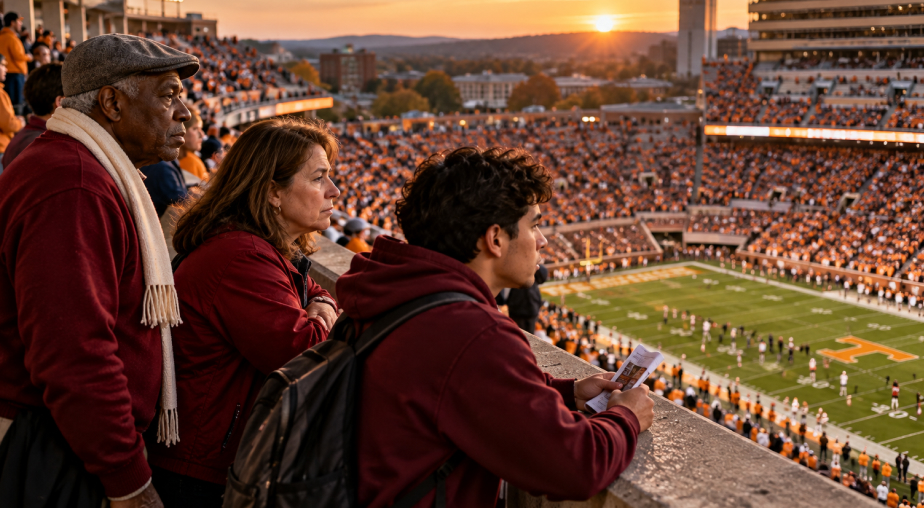
The arrangement was announced through cooperation between the two universities and the Southeastern Conference.
The official Alabama–Tennessee rivalry history records Alabama’s overall advantage at 61 victories, 40 defeats and eight ties following the 2026 matchup.
Yet the rivalry has become increasingly competitive in recent seasons.
Tennessee defeated Alabama 52–49 in 2022 and 24–17 in 2024.
Alabama responded with victories in 2023 and 2025 before suffering another defeat in Knoxville in 2026.
For Crimson Tide supporters accustomed to extended periods of dominance, the renewed competitiveness carries emotional significance beyond the conference standings.
The rivalry is a reminder that historical success does not guarantee future results.
Alabama’s championship tradition establishes expectations, but maintaining that standard requires continual improvement.
DeBoer’s responsibility is to preserve the competitive qualities associated with Alabama football while building an offense capable of succeeding under current SEC conditions.
What Kalen DeBoer Must Change Before Alabama Faces Texas A&M
Alabama’s next scheduled opportunity to respond comes October 24 against Texas A&M at Saban Field at Bryant-Denny Stadium in Tuscaloosa.
The Homecoming matchup is scheduled for 2:30 p.m. Central Time and will be televised on ABC.
With Alabama sitting at 5–2 overall, the game carries significance for both conference positioning and the team’s postseason ambitions.
DeBoer and his staff have several areas to address before the Aggies arrive.
First, Alabama needs more reliable early-down production. The offense cannot repeatedly place Russell in obvious passing situations and expect individual quarterback talent to overcome defensive pressure.
Second, protection and rushing efficiency must improve together. A more credible ground game could reduce the pressure on Russell while creating additional opportunities for play-action passing and manageable third downs.
Third, turnovers must become less frequent. Four giveaways against Tennessee made an already difficult road matchup considerably harder.
Fourth, Alabama needs better second-half offensive adjustments. Scoring three combined second-half points across two consecutive defeats is not sustainable for a team with conference championship aspirations.
Finally, the coaching staff must identify ways to generate production from multiple receivers and tight ends.
Against Tennessee, Rico Scott led Alabama with 54 receiving yards on four catches.
Marshall Pritchett caught a team-high six passes but gained only 39 yards.
The offense needs more consistent opportunities to create meaningful gains after receptions and threaten defenses beyond short passing routes.
None of these adjustments guarantees a victory against Texas A&M.
However, they provide a practical framework for evaluating whether Alabama is addressing the problems exposed in Knoxville.
Is Alabama’s Offense Now The Biggest Threat To Its Playoff Ambitions?
The evidence from the Tennessee game suggests that Alabama’s offense has become the team’s most urgent concern.
The Crimson Tide defense has shown an ability to generate turnovers, produce individual stops and keep games competitive.
Against Tennessee, the defense limited the Volunteers to four field goals in the first half despite Alabama’s offensive struggles.
The offense, by contrast, failed to generate consistent rushing production, protect possession or sustain drives.
Those problems became even more pronounced when compared with the previous week’s defeat against Georgia.
Alabama has now lost consecutive games against major SEC opponents while scoring only 27 combined points.
That is not enough offensive production to consistently defeat championship-caliber competition.
Still, it would be premature to declare DeBoer’s offensive system fundamentally unsuccessful based on two games.
The more useful question is whether Alabama can respond with measurable improvement.
Russell remains a developing quarterback with demonstrated mobility and passing ability.
The Crimson Tide still possesses experienced coaches, talented skill-position players and a program infrastructure built around competing for championships.
But those advantages must translate into performance.
The expanded College Football Playoff creates more potential postseason paths than the former four-team format, yet a 5–2 record leaves Alabama with little margin for additional setbacks.
The remaining schedule will test whether the Crimson Tide can restore offensive consistency against conference opponents.
For DeBoer, the immediate priority is not recreating the offensive production of previous Alabama championship teams.
It is developing an approach that allows the current roster to move the football, sustain possession and score against quality defenses.
Alabama’s Response Will Define The Next Chapter Of The DeBoer Era
Alabama’s 26–10 defeat against Tennessee was more than another rivalry loss.
It exposed a combination of offensive problems that have become increasingly difficult to overlook.
The Crimson Tide managed only 201 yards, committed four turnovers and failed to score in the second half.
Its running game produced little support, while Russell faced substantial pressure and struggled to create consistent passing opportunities.
The result followed a narrow defeat against Georgia, making the offensive decline particularly concerning.
Alabama’s defense has not been without weaknesses, but the evidence from the past two games points toward offensive execution as the more immediate obstacle to improvement.
The October 24 matchup against Texas A&M will provide an important measure of the coaching staff’s response.
If Alabama can establish a more dependable running game, reduce turnovers and improve third-down efficiency, the Crimson Tide may still have an opportunity to regain momentum.
If those problems continue, the pressure surrounding DeBoer’s offensive approach will intensify.
Alabama’s football history is defined by championships, demanding expectations and the ability to respond to adversity.
The next chapter of that tradition will depend less on the reputation of the program and more on whether its current offense can meet the competitive demands of the SEC.