

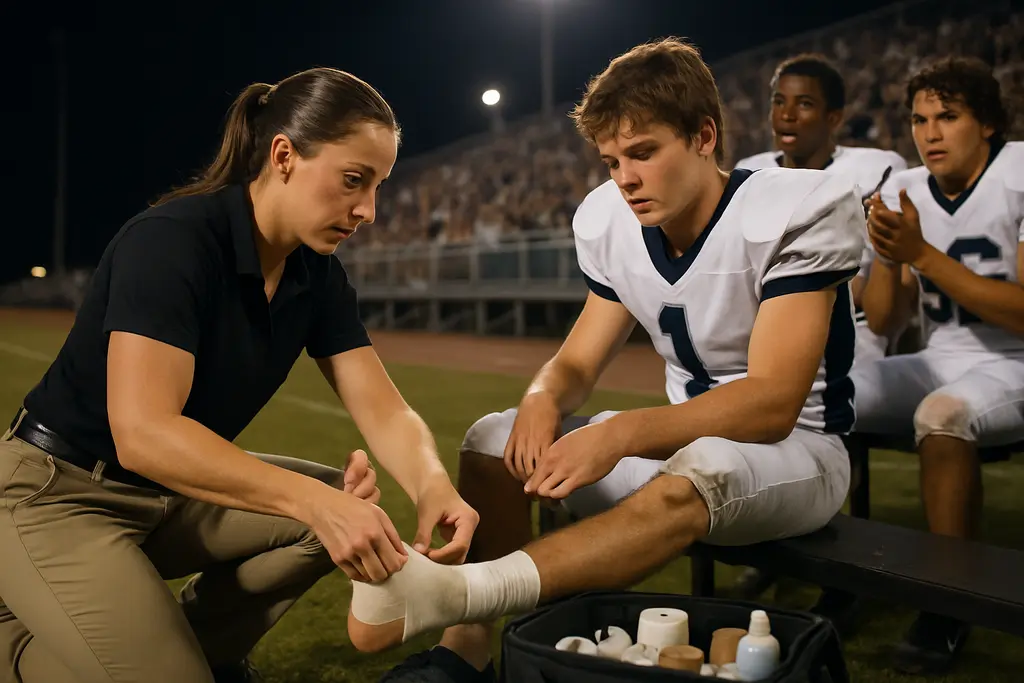
Full-Time Athletic Trainers have become part of the daily sports structure across Howard County Public Schools for the 2026-27 school year, a change that reaches far beyond the sideline. HCPSS approved funding for 13 full-time certified athletic trainers, one for each of its 13 high schools, with a $1.3 million allocation, according to CBS Baltimore. For athletes, coaches, parents and recruits, the move changes how practices, game coverage and injury response fit into the rhythm of high school athletics.
In prep sports, safety planning is not separate from performance. It shapes whether an athlete can practice with confidence, whether a coach can structure contact periods responsibly, and whether a family feels the school system is treating athletics as a serious extension of student life. Howard County’s decision carries special weight because it marks the first time HCPSS has guaranteed full-time athletic trainer coverage at all of its high schools.
Why Full-Time Athletic Trainers Changed Coverage
From Part-Time Help To School-Based Presence
Before the 2026-27 plan, HCPSS had eight part-time athletic trainers contracted to serve 13 high schools. That meant coverage depended on schedules, priorities and availability. The older setup leaned toward high-priority sports, including football, and playoff events. Regular practices and lower-profile sports could be left with less direct access to a trainer on site.
The new model places a certified athletic trainer at each high school as a daily presence rather than a visiting resource. That shift matters in a local sports community where practices often carry as much physical risk as games. Heat, contact, conditioning, sprains, collisions and return-to-play decisions are not limited to Friday nights or playoff rounds. For a coach trying to build roster depth, the daily availability of a trained professional can support better communication around athlete readiness.
Full-Time Athletic Trainers And Daily Presence
Full-Time Athletic Trainers also change the school day relationship between athletics and student support. A trainer who knows the teams, coaches, practice habits and facilities can spot patterns that a rotating or limited-schedule provider may not see as clearly. The trainer can also become part of the normal athletic routine, much like an equipment manager, strength coach or athletic director in larger sports programs.
Mt. Hebron’s hiring of Emily Dudley as a dedicated full-time athletic trainer was cited as an example of the transition. The significance is not just that one school added a named professional. It is that the model moved from game-only or event-based coverage toward someone present for regular practices and competitions. That is a major cultural shift for a public school system with 13 high schools and a wide range of sports participation.
What The Budget Decision Says About Priorities
A Student-Led Push In January 2026
The funding decision did not happen in a vacuum. In January 2026, Junie Ro, a student athlete from Marriotts Ridge High School, launched a Change.org petition urging retention of the $1.3 million budgeted for full-time athletic trainer positions. The National Athletic Trainers’ Association covered that student advocacy effort and noted concerns about injuries without proper medical evaluation through its NATA report.
That student voice is worth remembering. In many communities, the push for better athletic support starts with parents or coaches. Here, the research points to an athlete helping frame the issue publicly. For recruits and younger players, that matters. It shows that student athletes are not only participants in the system; they can help define what a safe competitive environment should look like.
Why The 2026-27 Funding Stood Out
The $1.3 million allocation stood out because full-time positions had previously been included in a superintendent’s proposed budget but were cut during final Board of Education budget approvals for FY 2025. By the 2026-27 school year, the school system moved in a different direction and funded the 13 positions.
That reversal is the kind of local sports decision that rarely shows up in box scores but affects every roster. A school may remember a rivalry win, a county championship or a postseason run, yet the conditions around those moments are set by budgets, staffing and facility planning. Athletic trainers sit squarely in that space. They are not there to win games, but their presence can support the environment in which athletes prepare, compete and recover.
How Student Safety Connects To Performance
Better Coverage Without Overstating Results
There is no public injury-rate data in the provided research showing that HCPSS has already reduced injuries because of the new staffing model. It would be wrong to claim measured results that have not been documented. What can be said is more limited and more responsible: daily access to certified athletic trainers gives each high school a consistent resource for evaluation, immediate response and communication around athletic health.
For performance, consistency is a practical advantage. A sprinter trying to manage soreness, a lineman working through contact practice, a soccer player returning from a hard challenge, or a basketball player dealing with an ankle issue all benefit from a school environment where the first conversation can happen quickly with a qualified professional. Coaches also gain a clearer point of contact when they have questions about whether an athlete should continue, sit out or seek further evaluation.
What It Means For Recruits And Families
For recruits, health support is part of the development picture. Families often ask about coaching, playing time, academic fit and competition level. They should also care about what happens after a player lands awkwardly, takes a hit, overheats during conditioning or needs follow-up after practice. Howard County’s move gives each high school a clearer answer to that question.
In Alabama, where high school football, basketball and baseball traditions run deep, communities have long understood that athletic infrastructure sends a message. The same principle applies in Maryland. A county that funds daily athletic trainer coverage is telling families that sports are not treated as an after-school extra with minimal support. They are part of the student experience and require grown-up planning.
- Each HCPSS high school was funded for one full-time certified athletic trainer in 2026-27.
- The plan replaced a structure with eight part-time trainers serving 13 schools.
- The change expanded the focus from select games and playoffs toward practices and broader team coverage.
- Student advocacy, including the January 2026 petition, helped keep attention on the issue.
Community Impact Across Howard County Sports

Small Changes That Shape A Sports Culture
Local sports culture is built through repeated habits. Parents see who is present at practice. Athletes learn whom to trust after a hard collision. Coaches learn how quickly concerns can be addressed. Athletic directors learn whether coverage plans are dependable or improvised. Full-Time Athletic Trainers help make those routines more stable across the county.
The equity piece also matters. Under the previous arrangement, coverage could tilt toward higher-profile sports. The 2026-27 approach recognizes that a volleyball player, wrestler, lacrosse player, runner or junior varsity athlete deserves the same baseline of care as a football starter under the lights. That is not a small statement in a countywide school system. It places the health of the athlete ahead of the crowd size around the event.
Why Coaches Gain A Stronger Partner
Coaches are not medical professionals, and they should not be placed in that role. A full-time certified athletic trainer gives coaches a trained partner who can help guide immediate next steps when a player is hurt or uncertain. That helps protect athletes and also helps coaches stay focused on instruction, roster management and team preparation.
There is a recruiting angle here as well. A program with consistent health support can present itself to families with more confidence. Not because it promises better outcomes, but because it has a clearer structure. In high school sports, structure is often what separates a well-run program from one that leaves too much to chance.
What Full-Time Athletic Trainers Mean For HCPSS Sports
Full-Time Athletic Trainers give Howard County Public Schools a stronger foundation for the sports experience in 2026-27. The change does not guarantee fewer injuries, faster recoveries or better records, and the available research does not provide outcome data to make those claims. What it does show is a countywide decision to place a certified professional in every high school athletic setting on a full-time basis.
For student athletes, that means a more reliable point of care. For parents, it means a clearer safety plan. For coaches, it means a better support system around daily practices and competitions. For recruits, it signals that HCPSS has taken a significant step in aligning athletic ambition with student well-being. That is the kind of local sports investment that may not lead a highlight reel, but it can shape the way a community trusts its school programs for years.