

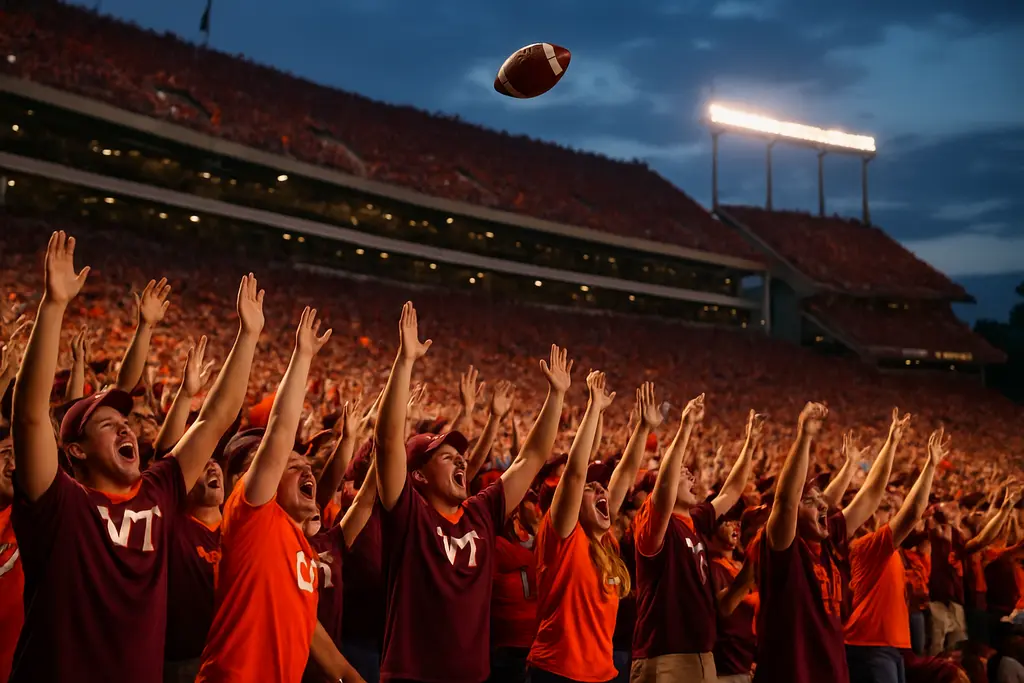
The Virginia Tech VMI matchup returned on September 5, 2026, and it did so with the weight of a long regional football memory behind it. Virginia Tech defeated VMI 73-3 at Lane Stadium, turning the scoreboard into a clear statement while also bringing back a series that had not been played since October 6, 1984. For communities in Blacksburg, Lexington, and Roanoke, the revival was about more than one afternoon. It restored a football connection that once helped define fall Saturdays and holiday gatherings across western Virginia.
Why Virginia Tech VMI Still Carries Weight
From 1894 To A Shared Football Identity
The series began in 1894, when Virginia Agricultural and Mechanical College, now Virginia Tech, first faced the Virginia Military Institute. That date places the matchup deep in the early period of Southern college football, long before modern conference schedules and national television windows shaped the sport. The rivalry has often been referred to as the original Military Classic of the South, a label tied to the schools’ cadet traditions and the old regional stakes of the game Virginia Tech archives.
Before the September 5, 2026 renewal, the programs had met 79 times, with Virginia Tech holding a 49-25-5 advantage. That record was already substantial before the series resumed. After the 2026 game, Virginia Tech’s all-time edge moved to 50 wins, while VMI remained at 25 victories with 5 ties, according to VMI’s official opponent history VMI series record.
Roanoke, Thanksgiving, And The Old Rhythm
The rivalry’s strongest public memory sits in the period when it was played regularly, especially from 1913 through 1971. During that stretch, the game was often associated with Thanksgiving Day in Roanoke at Victory Stadium. That detail matters because it shows how the contest reached beyond campus boundaries. It was not simply a Blacksburg game or a Lexington game. It became part of a regional sports calendar, giving families and alumni a fixed place to gather around football.
In Alabama, we understand how a rivalry can pull a full community into one week of the year. The Iron Bowl has its own identity, and the Magic City Classic carries another kind of civic and cultural pride. The western Virginia version had its own form: two military-rooted institutions, a Roanoke stage, and a Thanksgiving frame. That is why the return of the Virginia Tech VMI series carried more meaning than a standard nonconference date.
The 2026 Return At Lane Stadium
Virginia Tech VMI By The Numbers
The September 5, 2026 game ended with Virginia Tech ahead 73-3. It was the first meeting since Virginia Tech beat VMI 54-7 on October 6, 1984, in Norfolk. The gap between those games created a 42-year break, meaning an entire generation of students passed through both schools without seeing the series played in football.
The final score in Blacksburg showed the modern competitive gap between the programs. Virginia Tech, as an Atlantic Coast Conference program, carries a different resource base and weekly football schedule than VMI. VMI’s place in the series is not measured only by whether it can match Virginia Tech snap for snap in the modern game. Its value rests in institutional memory, the Keydets’ role in building the rivalry, and the way the schools once met often enough for the contest to feel like a seasonal marker.
A Lopsided Score With Historical Context
Football history is filled with one-sided rivalry scores, and this series had seen sharp swings before. VMI’s largest win over Virginia Tech came on November 23, 1950, by a 27-0 margin. The Keydets also owned a tight 22-21 victory on November 17, 1973, their smallest margin of victory in the series. Those results are reminders that the record book covers many eras, not one fixed balance of power.
Virginia Tech’s longest winning streak in the rivalry reached four games from 1982 through the 2026 meeting, while VMI’s longest streak was three games from 1939 through 1941. Those streaks are modest by rivalry standards, which says something about the older pattern of the matchup. For much of its life, the game had enough back-and-forth to remain rooted in memory on both sides.
What The Revival Means For Local Football

Restoring A Regional Sports Reference Point
Not every revived rivalry becomes competitive at once, and the 73-3 score made that clear. Still, the return carried value because it reconnected football fans with a fixture that had faded from active schedules. Rivalries are inherited as much as they are played. Grandparents and parents may remember the Roanoke era, while younger alumni only knew the series as a line in media guides and archive pages.
Bringing the game back to Lane Stadium gave the old series a new setting. Instead of Victory Stadium in Roanoke or the Norfolk site of the 1984 meeting, the 2026 renewal placed the matchup in Blacksburg, in front of a Virginia Tech home crowd. That changed the setting, but not the historical thread. The day linked the modern Hokies to their earlier identity as VPI and linked VMI to one of its longest-running football opponents.
Why Blowouts Can Still Matter
A lopsided result can make a rivalry feel uneven, but it does not erase what the matchup represents. College football traditions often survive because they carry family memory, school identity, and local geography. The Virginia Tech VMI rivalry sits in that category. The value is not limited to whether the game produces a close fourth quarter. It also lies in the chance to explain why the teams began playing in 1894, why Roanoke mattered, and why Thanksgiving once framed the meeting.
For VMI, the game served as a reminder of the Keydets’ long place in Southern football. For Virginia Tech, it offered a bridge from the modern Lane Stadium era back to an older regional schedule. For fans, especially those who care about local football roots, the renewal gave shape to a story that had been dormant rather than forgotten.
What The Virginia Tech VMI Revival Means Now
A Rivalry Reopened, Not Rewritten
The 2026 renewal did not rewrite the record book as much as it reopened it. Virginia Tech now leads the series 50-25-5, and the September 5 result will stand as one of the most decisive games in the rivalry’s long ledger. Yet the score should not be the only memory attached to the day. The broader point is that a series born in 1894 returned after a 42-year pause.
The Virginia Tech VMI revival also shows why schools sometimes revisit old opponents even when the modern football structure has shifted. These games give athletic departments, alumni, and local fans a chance to reconnect with matchups that shaped earlier generations. In this case, the revival brought back the original Military Classic of the South, gave Lane Stadium a historical date, and reminded western Virginia that football tradition is not always confined to active annual series.
For a sports historian, that is the lasting note. The Hokies owned the scoreboard on September 5, 2026. The Keydets still own a major place in the rivalry’s origin and long identity. Together, the two programs brought an old football thread back into view, and that makes the Virginia Tech VMI matchup worth remembering beyond the final margin.