

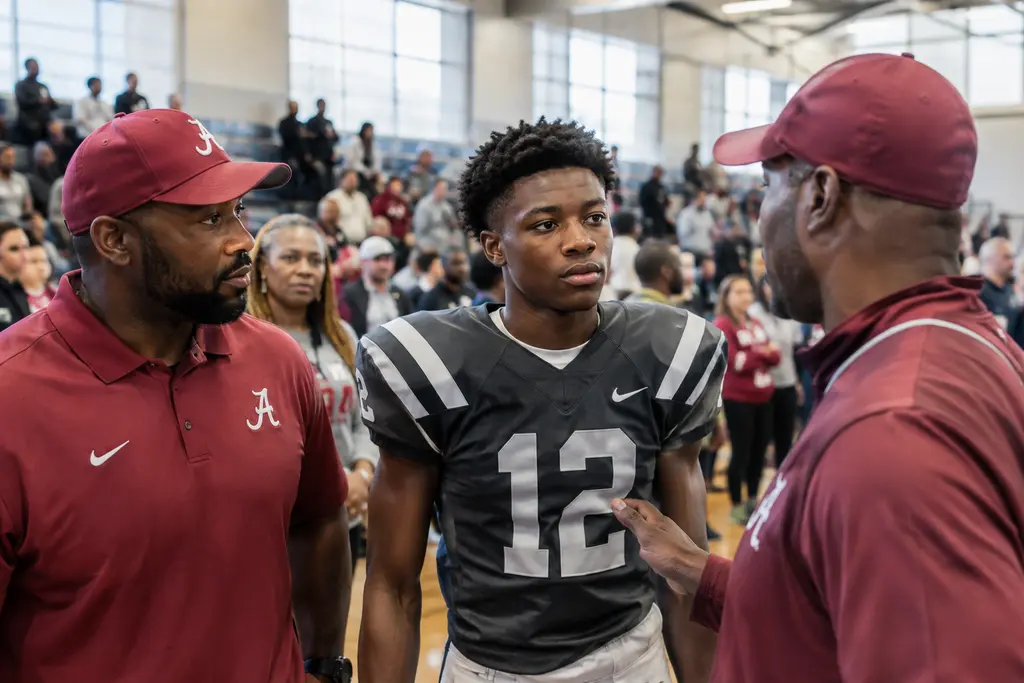
Alabama 2027 recruiting signals a clear turn in how the Crimson Tide is treating roster building, local evaluation, and athlete development. The class has not been defined by sheer size. Instead, the story is about fewer available spots, more attention on players already in the program, and a stronger need to win the right in-state battles before prospects leave Alabama’s high school pipeline.
Alabama 2027 Recruiting And The Smaller Class
Why Alabama 2027 recruiting Looks Different
The first clue came from Kalen DeBoer himself. On May 26, 2026, Alabama’s head coach said the 2027 class “will be much less than what we’ve had the last two seasons,” pointing to better retention and fewer seniors leaving the roster, according to On3’s DeBoer report. That is not a small detail in Tuscaloosa. For years, Alabama’s signing classes were judged partly by volume, blue-chip totals, and national ranking strength. In this cycle, the staff’s public stance has placed roster fit and retention closer to the center of the discussion.
The Alabama 2027 recruiting class also reflects a different moment in college football. By late September 2026, the research snapshot showed Alabama with 15 total commitments, No. 33 nationally in the Rivals Industry Team Recruiting Rankings, and 14th among SEC teams. Those numbers sit well outside the usual public expectation for a program that has long treated top-five recruiting finishes as normal. Commit totals can still shift before signing periods, so that September figure should be read as a snapshot rather than a signed-class record. Even so, it shows how much the public view of the class changed when Alabama chose a smaller lane.
Retention Changes The Meaning Of A Ranking
A smaller class can look underwhelming on a ranking page because ranking systems tend to reward both quality and quantity. A 15-man group has less room to pile up points than a 25-man class. DeBoer’s explanation matters because it frames the class as part of a roster-management plan, not only a recruiting race. If fewer veterans leave and fewer seniors cycle out, the staff has fewer scholarships to spend. That can make the high school class smaller even if the staff still lands players it values.
Yahoo Sports later framed Alabama’s approach as a deliberate strategy rather than a simple lack of momentum, noting the program’s small-class posture in a piece on how the plan looked smarter with time through Yahoo Sports’ Alabama analysis. The key for Alabama fans is to separate class size from player development. A shorter signing list puts more pressure on each evaluation, but it can also give the program room to grow players already inside the building.
Local Players Carry More Weight
In-State Names Change The Tone
The local angle is what gives this cycle its Alabama feel. By late September 2026, six of the 15 commitments in the research snapshot were from Alabama. The named in-state group included Alabaster quarterback Trent Seaborn, Tuscaloosa EDGE Jeremiah Beverly, and Selma wide receiver Cedrick Simmons. That does not mean Alabama has locked down every major in-state target. It does suggest the staff understands how much local trust matters when class size shrinks.
For communities across the state, those names carry weight beyond recruiting stars. Alabaster, Tuscaloosa, and Selma each represent different football identities. Alabaster has become a familiar stop for college recruiters. Tuscaloosa prospects grow up almost in the shadow of Bryant-Denny Stadium. Selma athletes carry their own local pride into every statewide football conversation. When Alabama takes a smaller group, each local pledge becomes more visible to high school coaches, families, and younger players watching from Friday-night bleachers.
Quarterback Development Sets A Public Standard
The class also leaned heavily toward offense in the September snapshot, with nine of 15 commitments listed for offensive roles. The quarterback room drew special attention because Alabama held commitments from Elijah Haven, a five-star from Baton Rouge, Louisiana, and Trent Seaborn, a four-star from Alabama. Haven is not an in-state player, but Louisiana remains close enough to fit the regional recruiting pattern that has long shaped SEC football. Seaborn, on the other hand, gives the class a direct Alabama high school storyline.
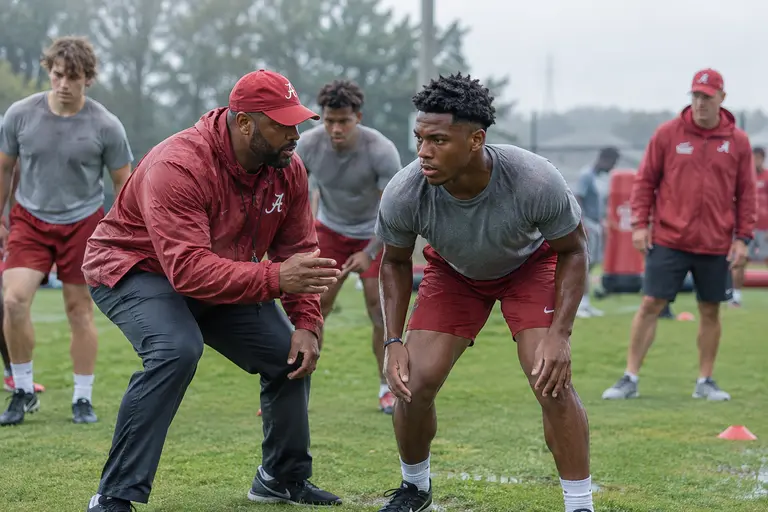
That two-quarterback structure says a lot about development. Alabama is not only collecting arms; it is creating competition early. The staff can evaluate how each passer grows inside its system, how they handle meeting-room demands, and how they respond to college weight training and practice tempo. For readers tracking the earlier shape of the cycle, our look at Alabama’s 2027 class blueprint followed how early commitments began forming the class identity.
Development Is Now A Roster Plan
The SEC Talent Drain Adds Pressure
One of the larger issues around the SEC is the challenge of keeping home-state players close to home. The research notes cite an AP analysis showing that in SEC states, the percentage of top-250 recruits staying home dropped from 72% in the 2022 cycle to a projected 53% for 2027. That trend matters in Alabama because the state produces enough high-end players to shape rosters at Alabama, Auburn, and rival programs beyond the state line.
If fewer top prospects stay home across SEC territory, player development becomes more than a phrase used on signing day. It becomes a survival skill. Alabama cannot assume that every blue-chip player in Birmingham, Mobile, Montgomery, or the Black Belt will wait for a late push from Tuscaloosa. The program has to identify fit earlier, build relationships with high school staffs, and show families a clear plan for growth after the commitment ceremony ends.
Flips And Reengagement Show The Fight For Alabama
The research record also points to contested local recruiting. Cedrick Simmons, the Selma receiver, was listed as flipping from Auburn to Alabama on July 15, 2026. Jatori “JT” Williams, a four-star interior lineman from Phenix City, was listed as reengaging with Alabama among finalists after decommitting from Miami on October 13, 2026. Those two situations are different, and the public record available here is limited, but both fit the same lesson: in-state recruiting is not passive.
For Alabama high school coaches, this shift can be meaningful. A smaller Crimson Tide class means fewer offers can become real takes. That may lead to deeper evaluation of practice habits, positional projection, academic readiness, and physical growth. It also places more value on camps, school visits, and long-term communication. The athlete who fits Alabama’s development plan may be more appealing than a player who simply adds another ranking point.
- Class size: The 2027 group was described by DeBoer as much smaller than the previous two cycles.
- Local presence: Six of 15 commitments in the late-September snapshot were from Alabama.
- Offensive tilt: Nine of those 15 commitments were listed for offensive roles.
- Quarterback focus: Elijah Haven and Trent Seaborn gave the class two major quarterback storylines.
What Alabama 2027 Recruiting Means For Local Development
A Smaller Class Raises The Standard At Home
Alabama 2027 recruiting has become a useful marker for how the program may handle local development under DeBoer. The class is smaller, but that makes each decision louder. If Alabama takes fewer prospects, the in-state players who earn spots become examples for the next wave of Alabama high school athletes. They show what body type, skill set, academic profile, and competitive habits the staff wants.
That is where this cycle reaches past national rankings. A Birmingham-area freshman, a Selma receiver, a Tuscaloosa pass rusher, or a Phenix City lineman can look at this class and see that the path is still open, but it may be narrower. The challenge for Alabama is to keep that path credible. The challenge for local athletes is to develop early enough that the staff sees more than potential; it sees a fit for a roster with fewer open chairs.
For Alabama 2027 recruiting, the shift is not simply about finishing higher or lower on a team list. It is about whether the Crimson Tide can retain its own roster, choose local prospects with care, and keep the state’s best high school players connected to Tuscaloosa. In a football culture built on Friday nights feeding Saturdays, that connection still matters.