

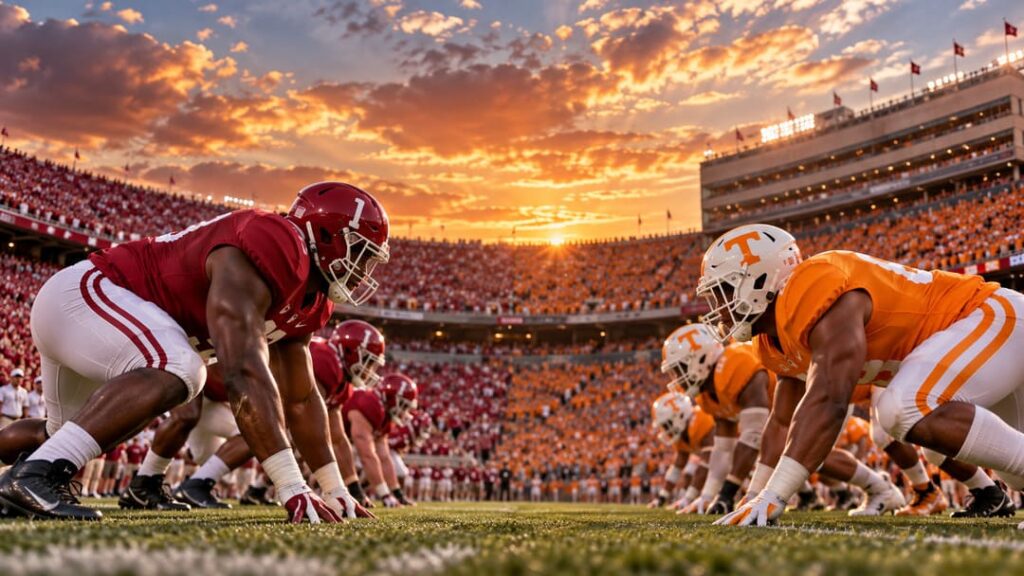
The Alabama–Tennessee 2026 rivalry will look different before the opening kickoff. When No. 6 Alabama visits No. 14 Tennessee at Neyland Stadium on Saturday, October 17, the Crimson Tide will wear crimson jerseys opposite the Volunteers’ traditional orange. It will mark the first time since October 17, 1970, that both programs have worn their home colors against one another in Knoxville. The game kicks off at 3:30 p.m. ET on ABC.
The return of those colors comes at a consequential point in the season. Alabama enters at 5-1 after a 20-17 loss to Georgia, while Tennessee is also 5-1 following a 24-17 road victory over Arkansas. Beyond the nostalgia, both programs are trying to establish where they stand in a competitive Southeastern Conference race.
Rivalry week also attracts discussion about rankings, point spreads and betting markets. Fans researching that side of college football should distinguish team performance from sportsbook reputation. For example, BetOnline user ratings concern feedback about a betting platform, not the likelihood of either team winning Saturday. The more useful football questions involve quarterback execution, available personnel and the lessons each team can take from its recent performances.
What Makes the Alabama Tennessee 2026 Rivalry a Historic Throwback
The return of crimson and orange is an organized revival rather than a one-game uniform experiment.
Under an agreement involving both universities and the SEC, Alabama and Tennessee will wear their home jerseys in their 2026 and 2027 meetings. Alabama’s official announcement of the jersey agreement confirms that the Crimson Tide will wear crimson in Knoxville this season, while Tennessee will wear orange when the rivalry returns to Tuscaloosa next year.
The historical reference is particularly significant because of what happened the last time both teams wore those colors at Neyland Stadium.
On October 17, 1970, Tennessee defeated Alabama 24-0 in a game remembered for extraordinary defensive production. The Volunteers intercepted eight passes, a school record, with defensive back Tim Priest responsible for three of them.
That game also featured a notable connection between the rival institutions. Tennessee coach Bill Battle had previously been a three-year starter at Alabama. Decades later, he served as Alabama’s athletics director from 2013 to 2017.
For longtime supporters, the uniforms connect multiple generations of a rivalry that has survived changes in coaches, venues, conferences and college football’s competitive structure.
The 2027 arrangement adds another historical first. Tennessee will wear orange jerseys at Bryant-Denny Stadium for the first time, since earlier Alabama-hosted meetings featuring Tennessee’s orange uniforms took place in Birmingham rather than Tuscaloosa.
The colors provide continuity. The teams wearing them will have to create their own chapter.
Four Recent Meetings Show Why History Cannot Decide Saturday
Alabama has enjoyed long periods of dominance in the series, but the most recent meetings tell a more competitive story.
The official Tennessee–Alabama series results show that the programs have split their last four contests, with the home team winning every meeting since 2022.
| Season | Location | Winner | Final Score |
|---|---|---|---|
| 2022 | Knoxville | Tennessee | 52–49 |
| 2023 | Tuscaloosa | Alabama | 34–20 |
| 2024 | Knoxville | Tennessee | 24–17 |
| 2025 | Tuscaloosa | Alabama | 37–20 |
The 2022 and 2024 Tennessee victories demonstrate why a trip to Neyland Stadium deserves attention. Alabama’s two home wins also show how quickly the balance can shift when the rivalry changes venues.
However, four games are too small a sample to establish that home-field advantage will determine the next result. Coaching decisions, quarterback play and available personnel change from season to season.
What those meetings do establish is that Tennessee has recently been capable of competing with Alabama, even as the Crimson Tide maintained the advantage in the 2023 and 2025 contests.
Saturday’s matchup begins with that history in the background, not with a predetermined outcome.
Alabama’s Biggest Challenge After the Georgia Loss
The most immediate Alabama question concerns how its passing offense responds against another ranked SEC opponent.
Quarterback Keelon Russell completed 16 of 30 passes for 185 yards and one touchdown against Georgia on October 10. He also rushed for 41 yards, accounting for 226 total yards in the 20-17 defeat.
Russell did not throw an interception, but Alabama managed just 17 points after entering the game with a much more productive offensive track record.
The performance added another chapter to a development story already visible earlier in the season. As examined in Crimson Traditions’ coverage of Keelon Russell’s growth after Florida State, the quarterback demonstrated the ability to respond to early challenges with improved decision-making and explosive production.
The Georgia game raised a different question: How consistently can Russell create offense when a disciplined defense limits his passing opportunities?
That challenge could become more complicated against Tennessee.
Ryan Coleman-Williams’ Injury Changes the Passing-Game Equation
Alabama coach Kalen DeBoer indicated on October 12 that leading receiver Ryan Coleman-Williams was unlikely to play against Tennessee.
Coleman-Williams has been dealing with knee and head injuries. Through six games, he had caught 23 passes for 415 yards and four touchdowns.
His potential absence would remove an established receiving target from an offense preparing for an important road assignment.
Lotzeir Brooks and Rico Scott offer alternative receiving options, but distributing production across multiple targets requires dependable route timing and protection.
That makes the offensive line especially important.
Earlier in the season, Crimson Traditions examined Alabama’s offensive line performance through three games, identifying encouraging rushing production alongside areas requiring better pass protection.
Those September numbers should not be treated as a complete assessment of the line in October. They do, however, identify an issue worth following: Alabama needs to preserve enough offensive balance to prevent Tennessee from concentrating its pressure on Russell.
If the Tide can sustain productive early downs, Russell should have more freedom to attack favorable passing situations. If Alabama regularly falls behind the chains, his protection and decision-making will face a much tougher examination.
Tennessee Faces Its Own Quarterback Questions
Tennessee enters rivalry week with momentum from its victory at Arkansas, but that performance also revealed issues requiring attention.
Quarterback George MacIntyre threw for 247 yards and a touchdown against the Razorbacks. He also had two interceptions, leaving Tennessee with ball-security concerns despite the seven-point victory.
The Volunteers gained 414 total yards, including 167 rushing yards, demonstrating that their offense could still generate production in a difficult road environment.
However, Tennessee’s quarterback situation remained unresolved at the beginning of rivalry week.
During Josh Heupel’s October 12 press conference, the Tennessee coach declined to confirm who would start against Alabama, indicating that the decision would develop as the team practiced during the week.
That uncertainty matters because Alabama’s defense presents a different challenge from Arkansas.
The Crimson Tide have the personnel to create disruption near the line of scrimmage and challenge quarterbacks to make quick decisions. Tennessee’s offensive effectiveness will depend partly on keeping the game manageable through its rushing attack, protection and ball security.
For Alabama, the priority is not merely pressuring the quarterback. The defense must also prevent Tennessee from creating explosive opportunities when plays break down.
The combination of Tennessee’s quarterback uncertainty and Alabama’s receiving concerns makes offensive execution one of the most important elements of the game.
The Rivalry’s Future Is Built on More Than Nostalgia
The return of crimson and orange gives Alabama–Tennessee something that cannot be manufactured through rankings or promotional campaigns: a direct connection to an earlier era of college football.
But the significance of October 17 goes beyond the uniforms.
Alabama must demonstrate that its first loss of the season has not disrupted the development of its offense. Russell’s response, the availability of his receiving targets and the team’s ability to protect the football will shape that assessment.
Tennessee has the opportunity to build on its recent success at Neyland Stadium against Alabama while resolving questions about quarterback stability and offensive consistency.
Neither program needs an exaggerated historical comparison to make the contest meaningful. The 1970 game belongs to its own generation, and the results from 2022 through 2025 provide context rather than guarantees.
The teams will bring back the colors of an old rivalry. What happens between the lines will determine how the 2026 meeting is remembered.