

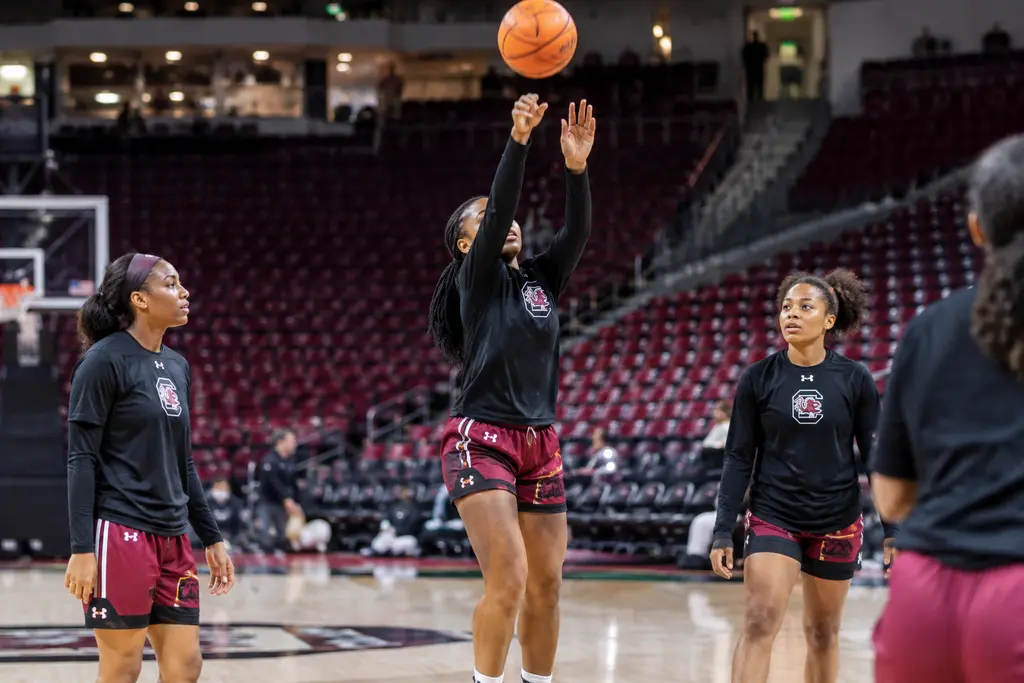
South Carolina Women’s Basketball entered the final week of October 2026 with the kind of standing that changes the rhythm around a college town. On October 20, 2026, the Gamecocks were ranked No. 1 in the Associated Press women’s preseason Top 25 poll, receiving 23 of 31 first-place votes, with UConn and USC next in the poll AP preseason poll. That number did not arrive by accident. It reflected sustained winning, roster continuity, player development, and a local fan base in Columbia that has treated women’s basketball as a central part of the city’s sports identity.
South Carolina Women’s Basketball Sets The Tone
Why South Carolina Women’s Basketball Earned No. 1
The No. 1 ranking carried weight because it followed a 2025-26 season in which South Carolina went 36-4 overall and 15-1 in SEC play. The research also shows the Gamecocks finished that conference run with a .900 win rate and a +37.8 point differential per SEC game. In a league where road trips, physical guard play, and frontcourt depth tend to expose thin rotations, those numbers tell a clear story: South Carolina controlled games with consistency, not just short bursts of talent.
The program’s 2025-26 production also reached record levels. The team set program marks for field goals made with 1,299, field goals attempted with 2,599, total points with 3,423, and scoring average at 85.6 points per game. Those figures matter because they show a style that did not depend on one narrow path. High volume, efficient scoring, and the ability to keep pressure on opponents have become part of the Gamecocks’ identity.
Roster Continuity And New Reinforcements
Returning production gave the ranking another layer of credibility. Joyce Edwards averaged 19.2 points per game on 57.1 percent shooting in 2025-26. Tessa Johnson ranked fourth nationally in 3-point percentage at 44.8 percent. Chloe Kitts, who missed all of 2025-26 with an ACL injury, was listed among the returning players. Those names point to balance across the floor: interior scoring, perimeter shooting, and frontcourt help returning to the rotation.
The new pieces also added to the sense that South Carolina Women’s Basketball was being judged on more than reputation. Veteran transfers Jordan Lee, from Texas, and Brooke Quarles-Daniels, from Michigan, were part of the incoming group. The freshman class was headlined by Oliviiyah Edwards, listed as the No. 3 recruit nationally, and Jerzy Robinson, listed as the No. 6 recruit. With that mix, the Gamecocks had both proven college experience and young talent joining a program already carrying national expectations.
Schedule Pressure And National Respect
Paris Opener And Ranked Tests
The ranking also came with an immediate scheduling challenge. The 2026-27 schedule included a November 2, 2026 season opener against Maryland in Paris, followed by early high-profile games against North Carolina, USC, UConn, and Duke, all part of a first-month stretch featuring five opponents ranked in the AP poll NCAA schedule report. That is not a soft landing for a No. 1 team. It is a schedule built to test matchups, guard depth, travel routines, and late-game decision-making before conference play sharpens the stakes.
From a historian’s chair, that sort of schedule carries a familiar SEC feel. Strong programs often use November and December to measure themselves against teams with different styles. Maryland, North Carolina, USC, UConn, and Duke each bring national name recognition, but the larger point is competitive strain. A team ranked first before opening night is not simply defending a number beside its name. It is showing whether its structure can hold against different tempos, personnel groups, and coaching adjustments.
What The Ranking Signals To Opponents
For opponents, South Carolina Women’s Basketball represents a measuring stick. The Gamecocks’ 269 consecutive AP Poll appearances, 138 straight weeks in the AP Top 10, and five preseason No. 1 openings across seven seasons all point to staying power. A single great team can lift a program for a year. A long poll streak signals something steadier: recruiting traction, staff continuity, and a player development model that keeps resetting the standard.
That is why the October 20 ranking felt less like a surprise and more like confirmation. The Gamecocks had already been operating from the front of the sport. The poll placed a number on what coaches, players, and fans had seen building through results, roster depth, and the program’s ability to keep drawing elite talent.
Columbia Fan Engagement After The Ranking

Colonial Life Arena As A Gathering Place
Local engagement is where the No. 1 ranking becomes more than a national headline. On October 21, 2026, Columbia hosted the GarNET and Black Madness fan event at Colonial Life Arena from 7 to 9 p.m. The event featured WWE-style team introductions, interactive fan games, team competitions, and a performance from Soulja Boy. Tickets were listed at $6 for the general public and free for students. By the time the event took place, the Gamecocks had just been named No. 1, giving the night a celebration tone without needing to manufacture one.
Two days later, on October 23, 2026, the schedule included a free exhibition against Benedict at Colonial Life Arena. With today’s date now October 25, 2026, those events belong in the rearview rather than the preview file. Their value, though, remains clear. They gave students, families, and longtime supporters a low-barrier way to connect with a team carrying national attention into a new season.
Student Access And Community Rhythm
Free student access at the October 21 event and the free exhibition on October 23 fit the kind of local outreach that keeps a college basketball program tied to its city. In places like Columbia, Tuscaloosa, Auburn, and other SEC towns, the strongest teams are often those that become part of weekly life. Students talk about them on campus. Families plan around home dates. Local restaurants and nearby businesses feel the push when arena crowds build.
South Carolina Women’s Basketball has reached the point where fan engagement is not limited to postseason runs. The preseason ranking, the arena event, and the exhibition schedule all worked together to make late October feel meaningful. That is one sign of a mature program: people show up before the official opener because the team has already earned a place in the community calendar.
What No. 1 Means For Columbia Fans
The Local Standard Around The Gamecocks
The No. 1 ranking means expectations are public, immediate, and fair. It does not guarantee anything about the November 2 opener in Paris or the ranked games that follow. What it does say is that voters saw South Carolina as the strongest starting point in the sport on October 20, 2026. For Columbia fans, that recognition affirms what many have watched grow over multiple seasons: a program with national reach and a hometown foundation.
South Carolina Women’s Basketball now carries the familiar burden of a top-ranked team. Every opponent can circle the date. Every slow stretch will be examined. Every rotation choice will draw attention. Yet that pressure is also part of the reward for sustained excellence. Columbia is not just hosting a highly ranked team; it is backing a program that has turned women’s basketball into one of the city’s defining sports stories.