


As of August 20, 2026, Patriots Player Development under Mike Vrabel can be read through two lenses: the scoreboard turnaround and the daily habits that made it believable. The New England Patriots went from two straight 4-13 seasons to a 17-3 record and a Super Bowl LX appearance during the concluded 2025 season, with Vrabel again earning AP Coach of the Year honors, according to The Washington Post. That kind of swing draws national attention, but the more lasting story is how a coach rebuilt expectations through meetings, practice contact, technical teaching, and internal competition.
Why Patriots Player Development Changed Under Vrabel
A Turnaround Built On Standards
Vrabel was hired in January 2025, and the research from his first season points to a staff trying to reset the program without pretending that slogans alone could solve losing. His method centered on standards players could see and repeat: effort and finish, ball security and disruption, details, technique and fundamentals, and sound decision-making. Those ideas were not treated as decoration. They were displayed in coaching settings and tied to how players were evaluated throughout the concluded 2025 season.
In football towns across Alabama, the best programs are often remembered less for one play than for how they practiced from Monday through Thursday. That same old lesson applies here. Vrabel’s first Patriots team did not simply add urgency on game day. The staff appeared to make urgency part of the teaching cycle: compete in the drill, finish the rep, protect the ball, take the coaching, and carry the correction into the next period. That is where Patriots Player Development moved from a front-office phrase into a working football habit.
Fresh Ideas Without Erasing Identity
By mid-June 2026, Vrabel had asked his staff to bring fresh ideas across offense, defense, and special teams. The research describes this not as a demand for wholesale change, but as a push for schematic refinements. That distinction matters. A staff that chases novelty can confuse young players. A staff that refines its base gives players a clearer path: learn the core, master the details, then add enough variation to stress opponents.
That approach fits Vrabel’s background as a coach who values physical proof. He did not appear to separate scheme from teaching. If the Patriots wanted pressure simulations on defense, line play had to be taught with clarity. If the staff wanted improved ball security and disruption, the standard had to show up during daily periods. The method was plain: the scheme should help players, but the players still had to earn trust through repetition.
Meeting Rooms Became A Culture Tool
Patriots Player Development Starts With Trust
One of Vrabel’s clearest culture moves came during the 2025 offseason, when he introduced what players called the “4 H’s”: hometown, heartbreak, hero, and hope. The exercise was used in team meetings to help teammates understand one another beyond football, as detailed by ESPN. That may sound simple, but locker rooms are built from shared pressure. When players know more than a jersey number and position group, correction can land differently.
Trust does not replace competition. In Vrabel’s structure, it seems to sharpen it. A player who knows his teammate’s background may still fight him for a roster spot, a role, or a practice rep. The difference is that competition becomes less personal and more tied to the team’s standard. Coaches across high school and college football have long understood that a hard room must also be a connected room. Vrabel used the 4 H’s to create that connection before the stress of the season tested it.
The 4 H’s As A Football Method
The four prompts also gave coaches a way to learn what drives each player. Hometown can reveal roots and pride. Heartbreak can reveal what a player has had to carry. Hero can reveal what kind of example shaped him. Hope can reveal where he believes the game can take him. Those details matter in development because teaching is not one voice speaking into empty space. Players hear coaching through their own history.
There is no public evidence in the research that this meeting structure can be tied to one individual statistical jump. It would be careless to claim that. What can be said is that Vrabel used the format as part of a broader program that coincided with a major team rise in 2025. The available reporting supports a culture-based reading more than a player-by-player statistical one.
Practice Technique Carried The Message
Hands-On Coaching In Joint Work
Vrabel’s practice style gave the culture work a physical edge. In early August 2025, during joint practice work, he inserted himself into drills, took contact, blocked players, and demonstrated technique up front. Players described the approach with respect because it showed a coach willing to place his body near the same work he was asking them to do. That matters in a league full of grown professionals. Authority holds up better when players believe the coach is present, not distant.
The research also notes that Vrabel slapped players’ hands to demonstrate body position, dropped into three-point stances across from linemen, and drew praise from coaches who said he “walks the walk.” Those moments may look small from the sideline, but they carry weight inside a practice field. A hand placement correction can say more than a long speech. A stance demonstration can tell a young lineman exactly what the staff means by pad level, balance, and finish.
Competition As Development
By August 8, 2026, reports from Patriots training camp described increased intensity, especially in one-on-one periods and line play. That detail fits the pattern from 2025. Vrabel’s program used competition not as theater, but as a sorting tool. Veterans and young players were pushed by internal contests, and the coaching staff could judge how technique held up against resistance.
For readers tracking the staff’s camp rhythm, our earlier note on how Vrabel set the Patriots camp tone fits naturally beside this development story. Training camp is where a coach’s language either becomes routine or fades into background noise. In Vrabel’s case, the evidence points to a staff keeping the pressure on the details after the 2025 Super Bowl LX run had already been achieved.
Scheme Refinement And Roster Teaching
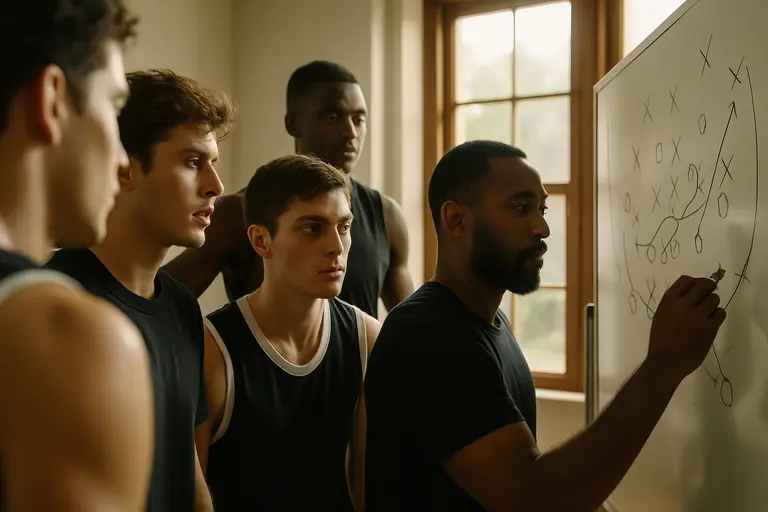
All Three Phases In The Same Conversation
Vrabel’s call for fresh ideas across offense, defense, and special teams in mid-June 2026 suggests that he did not want one unit carrying the identity alone. Special teams, often treated by casual fans as a side note, can teach the same traits coaches want everywhere else: finish, spacing, ball judgment, and assignment discipline. Offense and defense may produce the headlines, but a full-team standard is easier to sustain when every phase is coached with the same seriousness.
On defense, the research points to personnel-based schematic work, including pressure simulations and complex blitz packages, with Christian Gonzalez and Kyle Dugger named as important secondary pieces. The key is not simply that the Patriots could pressure. It is that pressure packages require communication, timing, and trust behind them. A defensive back must understand what the rush is trying to create. A rusher must understand how coverage helps him. Development, in that sense, is shared knowledge.
New Players Needed Day-One Clarity
During spring 2026, Vrabel’s staff worked to integrate 44 new players added through free agency and the draft. That number gives the development story a practical edge. A roster with that many new faces cannot depend on veterans passing down every expectation by memory. The coaching staff has to teach the language, the pace, and the consequences quickly.
Day-one clarity is especially valuable for rookies and lower-roster players. They may not receive endless chances to show they belong. If the standard is vague, evaluation becomes muddy. If the standard is clear, players can improve faster and coaches can make cleaner decisions. Vrabel’s emphasis on fundamentals, technical precision, and competition gave those new players a map for earning trust.
What Patriots Player Development Says About Vrabel
A Method Alabama Football People Recognize
From an Alabama football perspective, Vrabel’s approach feels familiar in its bones. It values the practice field as the place where identity is made. It respects the meeting room as more than a place to install plays. It treats technique as culture, not just instruction. That is the language spoken on Friday nights, Saturdays, and Sundays by programs that believe a season is built in increments.
The Patriots’ 2025 turnaround should not be reduced to one meeting exercise or one drill. The record, the Super Bowl LX appearance, and the Coach of the Year honor came from many football factors. Still, the thread through the reporting is consistent: Vrabel made development personal, physical, and competitive. He connected players through story, corrected them through action, and challenged them through daily contests.
Why The Method Lasted Beyond One Season
The most telling part is that the staff kept pushing in 2026 after the breakthrough had already happened. A coach satisfied by one leap might protect the formula. Vrabel instead asked for refinements while keeping the core. That balance is often what separates a temporary rise from a program standard.
Patriots Player Development under Vrabel is best understood as a full-room project. It touches the stars, the rookies, the linemen, the special teamers, and the new arrivals trying to learn the building. The public record does not support naming every individual gain, but it does support a clear cultural reading: Vrabel built a Patriots team that learned through trust, contact, technique, and competition, then carried those lessons into one of the sharpest NFL turnarounds of the 2025 season.