

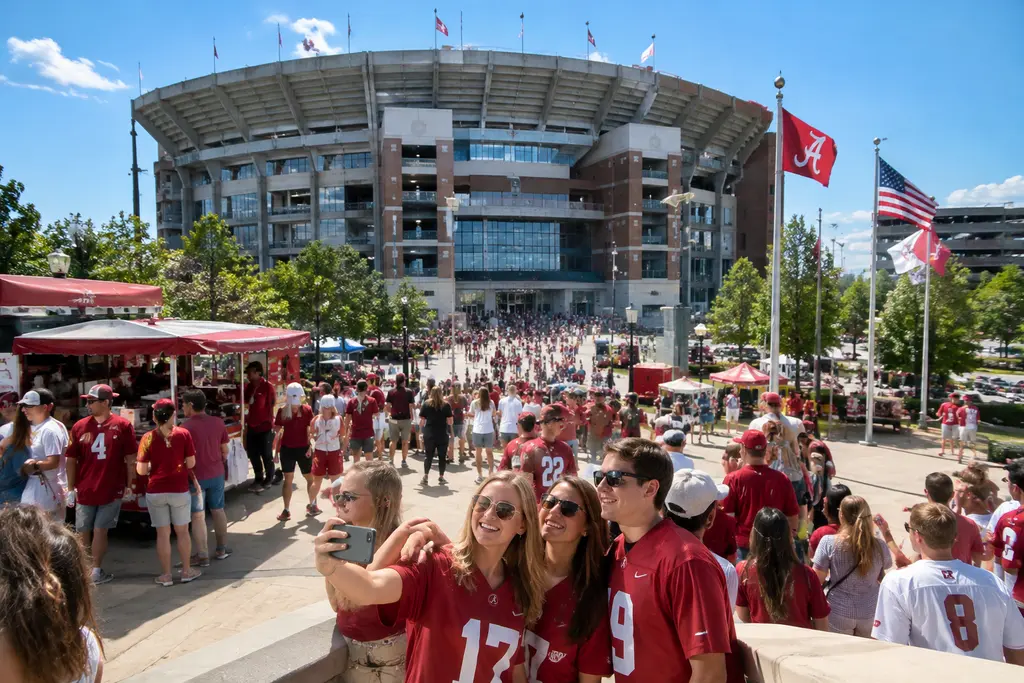
Alabama Game-Day Innovations at Bryant-Denny Stadium in 2026 were not just about technology. They were about helping a large football crowd move, gather, cool down, find its seat and keep long-standing Tuscaloosa rituals intact. For a program where the walk in, the first view of the bowl and the shared routines around campus matter nearly as much as the scoreboard, the changes carried a local meaning that went beyond convenience.
Alabama Game-Day Innovations At Bryant-Denny
Alabama Game-Day Innovations In The Gate Map
The most visible operational change was the new gate and section numbering system. Starting with the 2026 season, Bryant-Denny Stadium gates were renumbered clockwise from east to west beginning at the Walk of Champions, and seating sections moved from letter labels to standardized three-digit numbers. The lower bowl moved into the 100s, the upper bowl into the 800s, and premium skyboxes received cardinal direction designators, according to University of Alabama game-day guidance.
That kind of change can sound dry until a family is trying to meet grandparents outside the stadium, a student is finding a new bowl assignment, or a visiting fan is crossing campus from a parking area. Bryant-Denny has always been a place of repeated habits. Many Alabama supporters know their gate by memory, their approach by street, and their section by the people who sit nearby. Renumbering challenged those habits for a short time, but it also gave the stadium a clearer shared language for modern crowd movement.
Those Alabama Game-Day Innovations reflected a practical truth about major college football venues: tradition works best when people can reach it without confusion. The Walk of Champions remains a ceremonial anchor, but the updated numbering made that anchor part of a wider directional system. For local fans, that meant fewer vague meeting spots and a better chance for first-time guests to understand the building before kickoff.
Wayfinding, Heat Relief, And Food Choices
Guest Services Became Easier To Find
Alabama also placed new guest services tents outside Gates 6, 22, 28 and 40. Inside the stadium, kiosks were added on Level 1 near Sections 103 and 128, on Level 2 near Section 123, and on Level 8 near Sections 830 and 860. The listed services included phone charging, concession maps, promotional items, posters and sensory bags.
That reach matters in a stadium that hosts families, students, former players, recruits, visiting supporters and multi-generation season-ticket groups on the same Saturday. A guest services point near a gate can answer a question before it turns into a long walk in the wrong direction. A kiosk near an upper-level section can help a fan without forcing a trip back down through the crowd. Sensory bags also deserve notice because they show a wider understanding of who attends Alabama football games and what different fans may need to stay comfortable.
Hydration Was Treated As A Game-Day Priority
Early-season football in Tuscaloosa brings heat that locals respect. In 2026, Bryant-Denny Stadium had 16 refillable 150-gallon tanks of cold filtered water placed throughout the venue. Multiple water refill stations, sunscreen, shaded seating and cooling stations were also placed on lower and upper levels. Those details may not carry the romance of a pregame song, but they shape how long fans can safely remain in their seats, especially during afternoon kickoff windows.
The concession updates added another layer to the stadium experience. Select stands offered new items, including a Nashville hot fried chicken sandwich with Wickles and secret sauce, along with a spicy chicken and macaroni and cheese bowl. Stadium food has become part of how fans remember a game day. For Alabama, the change fit a familiar Southern football setting: people come to watch the Tide, but they also come to eat, talk and pass time with family before the fourth quarter arrives.
Mobile Access And Student Routines
Phones Became Part Of Stadium Movement
Free high-speed CrimsonTideWiFi throughout the stadium was part of the 2026 game-day package. That type of network access supported more than social posting. It helped fans call or text inside the building, check information tied to gates and concessions, and use mobile ticketing with fewer slowdowns. The WaitTime system, which debuted in October 2025 during Alabama against Vanderbilt, also carried into 2026 with real-time line information for security gates and concessions through the UA Crimson Tide app.
For many older fans, a phone-heavy stadium can feel different from the paper-ticket era. Yet the best use of mobile access is not to replace the shared feel of Alabama football. It is to reduce friction around it. If a fan can see which entry point is moving faster or find a shorter concession line, that person spends less time separated from the people and moments that define the day.
Students Saw A More Direct Ticket Process
The student side of the experience also changed. Student tickets were loaded onto ACT Cards each Sunday before home games. The MyTickets platform let students view balance, gate number and bowl assignment, while also supporting swap, transfer, donate and waitlist options. The waitlist opened on Sundays, with bowl assignments given once a student received a ticket through donations.
That may seem like administrative housekeeping, but Alabama football has long been one of the first shared experiences that connects students to the university. A clearer ticket process helps freshmen learn the stadium and helps upperclassmen adjust when class demands or family plans change. For more context on how schedule pressure and stadium habits shape local Saturdays, our notes on Alabama home games connect these routines to the wider Bryant-Denny fan experience.
Premium Seating And Stadium Memory

New Premium Plans Fit An Older Building
Premium seating was also part of the recent stadium work. Project plans called for adding four corner suites on each end of the two Zone Clubs, along with three new suites inside the existing press box. The total was listed at about 130 to 138 premium ticket opportunities in the Bryant-Denny premium upgrades document.
Premium projects often draw attention because they speak to revenue and high-demand seating, but at Bryant-Denny they also raise a cultural question. How does a stadium add modern amenities while protecting the collective roar that made it famous? The answer is rarely found in one suite plan or one seating chart. It comes from balancing new hospitality spaces with the student section, the band, the families in long-held seats and the visitors who recognize they are walking into one of the sport’s defining venues.
Champions Lane Extended The Day Outside The Gates
Vector Security Champions Lane returned in 2026 as a 60,000-square-foot fan festival area behind the northwest gates. It included live music, food trucks, interactive displays, meet-and-greets and up to four giant LED videoboards showing other college football games. It opened four hours before kickoff. Parmalee performed on September 19, 2026, and Justin Moore performed on October 10, 2026. Vincent Mason was listed as a November 28, 2026 headliner.
That outside-the-gates space matters because Alabama football Saturdays are not confined to the stadium bowl. The day begins on campus, in parking areas, along familiar walking routes and in the places where families reconnect. Champions Lane gave fans another structured gathering point before entry, which can help spread crowds while keeping the pregame energy close to Bryant-Denny.
Why Alabama Game-Day Innovations Matter In Tuscaloosa
Comfort Supports Tradition
The best Alabama Game-Day Innovations in 2026 worked because they respected the local rhythm. Clearer gates helped fans find their way. Water tanks and cooling stations addressed Tuscaloosa heat. Guest services kiosks gave people answers inside the building. Mobile tools made tickets, lines and communication easier. New food choices and Champions Lane gave the day more texture without removing the older customs that fans still value.
Alabama football has always asked its home crowd to do more than watch. It asks people to arrive early, teach children the songs, honor former players, welcome old friends and carry memory from one season to the next. Bryant-Denny Stadium’s 2026 changes were most successful where they made those acts easier. In that sense, the innovations were not separate from tradition. They were part of how a major college football community keeps its Saturday habits strong while serving the people who fill the seats.